There's a lot I like about the Christmas season. Festive decorations. Guilt-free gatherings of friends and family, complete with foods and beverages that are, strictly speaking, not good for one's body. The sense of excitement in the air. And, for Christians, a celebration of a Very Important Event.
Despite this, the season is one that generally fills me with dread. Let me count the ways: first, there's more to do and yet no additional time in which to do it, which increases stress. Second, repetition of seasonal songs, in a mind-numbing number of versions, usually performed in a perfunctory manner, inflicted on an unwary public. (One of our discussions this year was "Holiday songs I never want to hear again," which occasioned a great many variations on "Wonderful choice!") Preparing for guests to stay over. Preparing to drive, usually through heavy traffic, to visit relatives. The hassle of shopping for people who either have everything they need or want nothing more than the universal gift certificate. (Watching people open gift cards is a dull activity, matched only by receiving such a card when there's no way to spend it until the next day at the earliest.)
Lost in all the shuffle are the normal things one would do over the course or a week or two. Most of those things are not important, but some require a certain amount of sacrifice. To wit: as I type this, I have yet to see the Christmas episode of Doctor Who, "The Time of the Doctor." I have had to avoid all discussion of the episode. I'm told some guy named Capaldi shows up in it, but I have no direct knowledge of this. The things I sacrifice for the sake of the season!
Lest anyone think this is merely a litany of complaints, I hasten to add that I genuinely enjoy the company of my relatives. If any of said relatives are reading this, yes, I mean it, and I'm not just saying so for the sake of smoothing some feathers come next Christmas.
Christmas is also the time when, over a few drinks, friends and relatives are liable to share the more interesting, not to mention embarrassing, pieces of gossip. Items that would never be forthcoming over the telephone or via mail (electronic or otherwise), and certainly never hinted at in the Christmas letter that stays resolutely chipper, come lightly off a tongue loosened by liquor. Little Bobby's close encounter with law enforcement after running that red light, or the explanation for why Uncle Fred is not with us this year (still in rehab). One is reminded of the foibles of one's nearest and dearest. My stepmother, a genuinely warm-hearted person, is also increasingly deaf and staunchly unwilling to do anything about it, so she'll take opportunities to turn up the volume on to the point of distraction on the television, and is unaware that the Christmas tree that plays nothing but a tinny version of "Jingle Bells," over and over, is a seasonal version of water torture. My uncle mercilessly baits the woman. And so it goes.
Which brings me to the Christmas Hangover. Oh, you thought the title was a metaphor for the post-holiday letdown? Perhaps it is that as well. But the CH is a genuine phenomenon. Extracting gossip requires not only plying others with drink, but keeping up as well. I'm also convinced that trying to pay attention to multiple conversations, all held at high volume, causes alcohol to be absorbed more quickly into the bloodstream.
This year, my best efforts were destroyed by the confluence of two kind gestures. Back in June, Uncle J__ bought his brother a bottle of Sauternes for the latter's 80th birthday. Said bottle was saved until Christmas, when all of legal drinking age assembled could have a glass of the sweet dessert wine. A temporary madness descended on me, and I forgot my vow forsaking all sweet alcoholic beverages after an unfortunate episode involving Rusty Nails. (To this day I cannot look at a bottle of Drambui without feeling slightly ill.) One glass and - bam! - the next morning was a sad occasion. In fact, I missed most of December 26. If I could have regenerated, I might have done so.
So let this be a cautionary tale to young people with strong constitutions and poor judgment: one day, that strong constitution will be gone, leaving only the poor judgment. When that day arrives, woe betide you. Until then, I envy you.
And now another Christmas has come and gone. For now, only the cleanup remains, itself another form of post-holiday hangover in which decorations return to their cramped little boxes, furniture is moved back to its normal location, and the trash and recycling bins bulge under the onslaught of wrapping paper, boxes, and the remains of that casserole that no one really liked. And in just 51 weeks, we do it all over again.
Saturday, December 28, 2013


Friday, December 20, 2013
Victorian Fantasy: "La Belle Dame sans Merci"
This month’s meeting of the Victorian Fantasy discussion group addressed John Keats’s “pocket epic” poem of 1819, “La Belle Dame sans Merci.” Sir JJ Drinkwater coined that oxymoron, and what an appropriate term it is!
Despite its brief length, a mere twelve stanzas of four lines each, the poem relates a tale in which a traveler encounters a knight, “alone and palely loitering” in a place where “the sedge has withered from the lake, and no birds sing.” The knight then tells of meeting a lady - “full beautiful - faery’s child” - who, “in language strange,” declared her love for him. The lady induces the knight to sleep, where he dreams of “pale kings and princes too, pale warriors, death-pale were they all” who were similarly seduced by the fae lady. He awakes, alone, on the hill where he met the traveler.

The Poetry Foundation describes the poem as follows:


Despite its brief length, a mere twelve stanzas of four lines each, the poem relates a tale in which a traveler encounters a knight, “alone and palely loitering” in a place where “the sedge has withered from the lake, and no birds sing.” The knight then tells of meeting a lady - “full beautiful - faery’s child” - who, “in language strange,” declared her love for him. The lady induces the knight to sleep, where he dreams of “pale kings and princes too, pale warriors, death-pale were they all” who were similarly seduced by the fae lady. He awakes, alone, on the hill where he met the traveler.
Left to right: Dame Kghia Gherardi, Mr. Simeon Beresford, Miss Sanchia Bumblefoot
The Poetry Foundation describes the poem as follows:
This dialectical probing of enchantment, of the always-threatened artifice by which imagination seeks its fulfillment in the world, initiates Keats’s most profound meditations in the spring of 1819. The dangers of enchantment deepen in the haunting, beautifully suggestive ballad, “La Belle Dame sans Merci,” written 21 or 28 April 1819, and published in a slightly altered version by Hunt in his Indicator of 10 May 1820. Here a knight-at-arms is seduced by a strange, fairylike woman, reminiscent of Morgan Le Fay or Merlin’s Niniane, and in the midst of this enchantment a warning dream comes to him from other lost princes and warriors. But his awakening from her does him little good; he wanders “palely” on “the cold hill’s side,” where “no birds sing,” a world as empty of charm as the fay’s was empty of real life. The poem has been seen as allegorical of Keats’s ambivalent feelings for Fanny Brawne or for poetry itself. More fundamental, though, is Keats’s growing sense, here and in his letters, of the dark ironies of life, that is, the ways in which evil and beauty, love and pain, aspiration and finitude, are not so much “balanced” as interwoven in ways that resist philosophical understanding. The more we imagine beauty the more painful our world may seem—and this, in turn, deepens our need for art.
Back row: Miss Janet Rhiadra, Miss Zanicia Chau; Front row: Miss Morgan Trevelion, me
Our group discussed the nature of the knight and of the lady; how much time passed when the knight was with the lady; whether she was seductress or whether it was merely her nature that men fell in love with her; and Keats’s influence (folk ballads) and others who may have been influenced by the poem (Tolkien was one suggestion).
Miss Ravenstask Bayr and Miss Galiena De Tourney
Sir JJ Drinkwater, Miss Herndon Bluebird, Miss Thuja Hynes, Miss Ellie Mink
Other interpretations of the poem may be found here and here, both apparently part of a syllabus from a Citiy University of New York English class.
As one can see from the pictures, we had quite a number of people (plus a few stragglers not pictured), many of whom were familiar with Keats in general and this poem in particular. That made for a good, lively discussion, which is always a treat.
The next meeting is scheduled for January 16, where the topic will be the 1850 novel The King of the Golden River, by John Ruskin.
Saturday, December 14, 2013
The Station and the Dead City
A new(-ish) Steampunk build and RP area, I first learned of The Station from the inimitable Honour McMillan. Above the ground, it’s a floating Steampunk city, with a high-speed train, a Fun House, the Orpheum theater, and more.

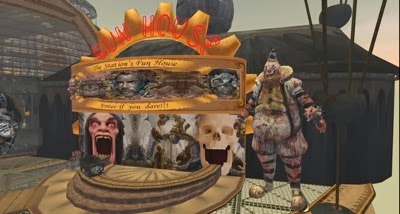


The central area of The Station
The entrance to the Fun House
The Orpheum
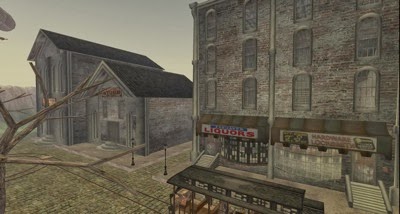
On the ground is the Dead City - an older, disheveled part of town, so to speak, but a misnomer because the city isn’t dead at all. To get there, one can take the civilized route - a balloon - or the Fun Ride, a wild, careening shot through a series of tubes. Naturally, I chose the latter.
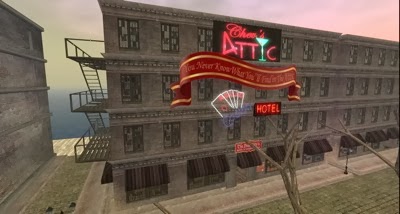
Below there are a number of other places to visit, including the hotel (with Chev’s Attic, a nightclub, and a ground-floor casino), an amusement pier, and the old Orpheum theater.
The hotel, where rooms by the week are available
The entrance to the amusement pier
Shopping in the Dead City, with a passing trolley
The two cities constitute an RP area. Fortunately for my ability to take pictures, but unfortunately for the continued viability of the area, no one else was there during my visit. It’s an intriguing setup, so I hope it catches on.
Tuesday, December 10, 2013
Review: Sapphire and Steel
Reading about Doctor Who, I saw a number of references to another British television show, Sapphire and Steel, which ran on ITV from 1979 to 1982 and is now available on DVD.
The show follows two “elementals,” Sapphire (Joanna Lumley of The New Avengers and Absolutely Fabulous fame) and Steel (David McCallum, from The Man from U.N.C.L.E. and currently in NCIS). As Sapphire says, “It’s our job to safeguard the structure of time.”* Each story - an “assignment,” in the show’s language, is made up of multiple half-hour episodes. The agents arrive on scene with a vague idea about what’s wrong, and spend the assignment investigating and resolving the issues. This site provides a more thorough description of the series.
Steel is generally grim-faced and, yes, steely, demanding answers from those around him and generally playing the heavy. Sapphire has certain powers to analyze objects and rewind time, and knows about the habits and customs of humans. They are occasionally aided by other agents, namely Lead (a large man who can knock down doors with a single blow) and Silver (a “technician,” rather than an “investigator,” who can manipulate metals and machinery when not flirting with Sapphire).
The show seems to have been shot on a budget of about $25 per episode. There is generally a single set, whether it’s a house (assignments one, four, and five), a train station (assignment two), an apartment building (assignment three), or a gas station-cum-diner (assignment six). The number of speaking parts is limited, and the combination of the single set and limited number of roles gives the show the feel of a staged play.
In Assignment One, creatures are using children’s nursery rhymes to enter the corporeal world. In Assignment Two, a man in a disused train station is attempting to make contact with the spirit world and finds soldiers killed in battle trying to return to life. In Assignment Three, time travelers from far in the future come to 1979 to understand the period - but they with them a force that can influence time. In Assignment Four, Sapphire and Steel investigate a man with no face who can take children out of photographs. In Assignment Five, a 1930-themed dinner party creates a shift in time so that the guests find themselves actually in 1930, where guests are murdered one at a time. In Assignment Six, the time agents are in a gas station in 1981, where a couple from 1948 has arrived in their car. The last two stories are the best, most coherent ones of the series.
One difficulty with the show is that it’s too mysterious for its own good. We never learn what these “elementals” are - certainly not human, despite their form, but also capable of being killed - or who they work for, or how time can get out of whack. We never seen any underlying logic to the show’s universe, so that much of the peril for Sapphire and Steel, and many of the resolutions, seem to come out of thin air. The two leads, Lumley and McCallum, are accomplished actors who try to overcome the often-weak material. The show deserves credit for creating something out of the mainstream, with an intriguing premise, but is ultimately let down by its scripts and its incomplete vision of its own universe.
------------
*No, neither sapphire nor steel are elements.
Tuesday, November 26, 2013
Review: "The Day of the Doctor" and "The Five(ish) Doctors Reboot"
Spoilers aplenty, so don’t say you weren’t warned. If you haven’t seen the 50th anniversary episode yet, watch it first. No, really, I mean it.
At the risk of adding yet more verbiage to what’s already out there, and repetitive verbiage at that, “The Day of the Doctor” was fantastic. The episode started with the original, black and white opening and theme song. We got an amazing new Doctor in John Hurt - who played the War Doctor as both arrogant and yet desperate to avoid the solution that he sees as the only way to end the Time War -, some explanation for why Queen Elizabeth I doesn’t like the Doctor, more Kate Lethbridge-Stewart in U.N.I.T., some Doctor-on-Doctor banter, a glimpse of Peter Capaldi’s Doctor, a sob-inducing resolution to the Time War, and then, just when you think all the twists are don, a scene with TOM BAKER!
In 80 minutes, we had two interwoven stories: the War Doctor on the last day of the Last Great Time War and his decision to end the war; and a Zygon invasion of Earth, starting in the 16th century and culminating in the present day.
I was sure the resolution of the Time War wouldn’t just be the War Doctor pushing the button, as we were told he did prior to this episode. Having brought viewers into the war, the outcome had to be different. I thought the resolution was when Ten and Eleven said to Hurt (shall we call him Eight Point Five?), “You’re not alone this time,” forgiving him/them from pushing the button - three hands resting on the Moment, ready to activate it. But Clara urges them to rethink the solution and find one that the Doctor - all of them - can live with. They devise a plan to use 13 TARDISes to zap Gallifrey into a pocket universe in order to save its inhabitants and let the Daleks kill one another. Perfect. (Except now we have to search for Gallifrey and bring back those insufferable boors, the Time Lords.)
Better yet, the two key aspects of that solution, the Zygon device to stick people into pictures and the property of the sonic screwdriver to do calculations in the background over a period of centuries, were foreshadowed earlier in the episode in other contexts, so the ending didn’t seem so made up on the spot. Thus, the B plot - the Zygons - was integral to the A plot - the Time War.
My biggest quibble is that we never got a resolution to the Zygon plot. We leave them negotiating something with U.N.I.T., but negotiating what? The Zygons want Earth and the humans aren’t inclined to give it up. Not a lot of room for bargaining in what seems like a zero-sum game. Otherwise, an amazing episode that lived up to all the buildup.
Another superb 50th anniversary show was “The Five(ish) Doctors Reboot,” a half-hour show written and directed by Peter Davison. The title is a takeoff of the 20th anniversary episode, “The Five Doctors” (which itself needed an “-ish” attached to the title, as Tom Baker appeared only through clips from “Shada” and another actor stood in for the late William Hartnell).
The “reboot” is a sweet shout-out to the fans of the classic series, bringing back Davison, Colin Baker, Sylvester McCoy, and, briefly, Paul McGann. It’s best to think of them as playing actors who once portrayed the Fifth, Sixth, Seventh, and Eighth Doctors. Davison, Baker, and McCoy all want to wrangle roles in the 50th anniversary episode but no one will cast them in the show. (Steven Moffat plays himself, frustrated with their repeated calls, and Russell T. Davies appears later on.) Davison induces the others to picket BBC’s Television Centre, to complete indifference from passers-by. John Barrowman arrives, telling them the show is now made in Cardiff. After an amusing bit playing off his sexual orientation, Barrowman takes them to Wales. They swiped their old costumes from The Doctor Who Experience, sneak onto the set, and… well, you’ll have to watch to see if they’re successful.
The number of in-jokes and cameo appearances by actors who have appeared in Doctor Who - David Tennant, Georgia Moffett, Lisa Bowerman, Nicholas Pegg, and more - along with sons of both Patrick Troughton and Jon Pertwee, were enough to satisfy the nerdiest fan of the classic series. The actors were willing to poke fun at themselves as being obsessed with participating in the show. (One might also think they were poking fun at fans obsessed with seeing older Doctors in the anniversary show.) McCoy has a running gag about appearing in The Hobbit, Davison’s grandkids are unimpressed with his past as the Doctor, and Tennant forgets to ask his wife (Moffett) how it’s going as she is giving birth. Well done, and kudos to those involved for making it.
Add to that the two mini-episodes, “The Night of the Doctor” and “The Last Day,” and it was a great anniversary celebration. I can’t wait for number 100.*
*By then I hope that modern medicine will have found a way to keep me going in my late 90s.
Friday, November 22, 2013
Victorian Fantasy: Christina Rossetti's "Goblin Market"
Having missed last month’s meeting of the Victorian Fantasy discussion group, on J. M. Barrie’s Peter Pan, as I was out of town that day, I was happy to be back this month to discuss Christina Rossetti’s poem “Goblin Market.” Although fewer attended than usual, there was a lively discussion from a mix of regular members and newcomers.
Rossetti, sister of pre-Raphaelite artist Dante Gabriel Rossetti (who prepared illustrations for his sister’s 1862 book Goblin Market and Other Poems), publicly claimed that the poem was intended for children, while privately saying the opposite. The poem certainly contains vivid sensual imagery, starting with a lengthy description of the ripe fruit the goblins are selling, fruit that is “Sweet to tongue and sound to eye.” Two sisters listen to the goblins calling out while hiding from them. Lizzie “veil’d her blushes” though the sisters had “tingling cheeks and finger tips” at the men.
Despite warning Lizzie that the sisters “must not look at goblin men” or “buy their fruits” as “Who knows upon what soil they fed their hungry thirsty roots?”, Laura does look, and is tempted by the goblins’ wares. Although Laura has no money, the goblins ask for nothing but a lock of her hair and she gorges herself on their fruit. Later, though she wants to return to the market for more, she can no longer hear the goblins and begins to waste away. In desperation, Lizzie returns to the market to buy fruit for her sister. The goblins, upon hearing that the fruit is not for her, viciously assault Lizzie and attempt to force their fruit upon her. She resists. Returning home, Laura tastes the juices of the fruit left on Lizzie and, though now repulsed by the taste, Laura is restored to health the next morning.
Although the discussion focused on the sensual, even sexual imagery in the text and the view that the poem is a metaphor for relations between men and women, some suggested alternative explanations, including the idea that the aggressive goblins represented advertising methods of the time, or that the poem was about sisterly love, or even the possibility that, as Rossetti claimed publicly, that the poem was meant for children and that the story was a tale to amuse and scare the young. In any event, all seemed to enjoy the work and the multiple possible interpretations of it.
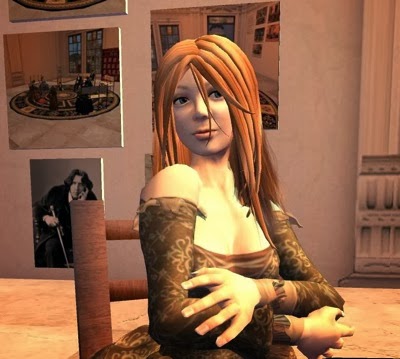
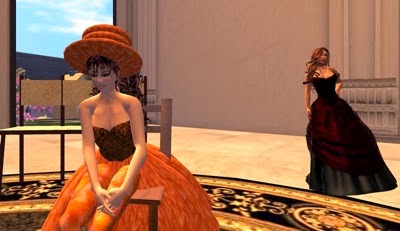
Participating in the discussion were:





Rossetti, sister of pre-Raphaelite artist Dante Gabriel Rossetti (who prepared illustrations for his sister’s 1862 book Goblin Market and Other Poems), publicly claimed that the poem was intended for children, while privately saying the opposite. The poem certainly contains vivid sensual imagery, starting with a lengthy description of the ripe fruit the goblins are selling, fruit that is “Sweet to tongue and sound to eye.” Two sisters listen to the goblins calling out while hiding from them. Lizzie “veil’d her blushes” though the sisters had “tingling cheeks and finger tips” at the men.
Despite warning Lizzie that the sisters “must not look at goblin men” or “buy their fruits” as “Who knows upon what soil they fed their hungry thirsty roots?”, Laura does look, and is tempted by the goblins’ wares. Although Laura has no money, the goblins ask for nothing but a lock of her hair and she gorges herself on their fruit. Later, though she wants to return to the market for more, she can no longer hear the goblins and begins to waste away. In desperation, Lizzie returns to the market to buy fruit for her sister. The goblins, upon hearing that the fruit is not for her, viciously assault Lizzie and attempt to force their fruit upon her. She resists. Returning home, Laura tastes the juices of the fruit left on Lizzie and, though now repulsed by the taste, Laura is restored to health the next morning.
Although the discussion focused on the sensual, even sexual imagery in the text and the view that the poem is a metaphor for relations between men and women, some suggested alternative explanations, including the idea that the aggressive goblins represented advertising methods of the time, or that the poem was about sisterly love, or even the possibility that, as Rossetti claimed publicly, that the poem was meant for children and that the story was a tale to amuse and scare the young. In any event, all seemed to enjoy the work and the multiple possible interpretations of it.
Participating in the discussion were:
Sir JJ Drinkwater
Dame Kghia Gherardi
Miss Janet Riadra
Miss Sanchia Bumblefoot
Miss Curious Sciurus (foreground)
Mr. Michael Romani
Mr. David Raymondson, typing on his clever keyboard while also smoking a cigar
Your humble author
Wednesday, November 20, 2013
Number Eight and "Night of the Doctor"
Although anyone who really cares has no doubt already seen and analyzed in painstaking detail “The Night of the Doctor,” I’ll add my few cents.
This mini-episode, a prequel to the 50th anniversary episode of Doctor Who (cleverly entitled “The Day of the Doctor” - the link is to a trailer for the episode), which arrived a week earlier than planned, according to Paul McGann, because it was about to be leaked, provides a little more context for the 50th anniversary episode. More importantly, however, it provides a connection between the series’ past - particularly Paul McGann’s Eighth Doctor - and the current incarnation of the series. It also incorporates the Big Finish audio stories into the Doctor Who canon in a dramatic way. As a fan of both McGann and the Big Finish stories, I was grateful for the mini-episode.
To recap: when we last saw Paul McGann on television as the Doctor, in the 1996 movie Doctor Who, he had regenerated from the Seventh Doctor and saved the world from yet another crazy plan by the Master. Along the way, he had a make-out session with Dr. Grace Holloway (Daphne Ashbrook), who turned down his offer to travel with him. Although the movie never developed into a back-door pilot for a new Who series, thanks largely to abysmal ratings in the U.S., and is generally panned because of its lousy plot, starting with the initial voice-over, in which the Doctor explains how he was on his way back to Gallifrey from Skaro - say, wasn’t the planet blown up in “Remembrance of the Daleks”?) with the remains of the Master (the Doctor seemed an unlikely emissary, as enemy of both the Daleks and the Master), whom the Daleks had put on trial and executed (trial? Daleks? Since when have they had a measured judicial system?). Nevertheless, many people, including me, thought McGann made a terrific Doctor, nailing the character from the beginning, and looking the part, wig and Wild Bill Hickok outfit not withstanding. It was a real shame we didn’t see more of him.
Big Finish, however, obliged the fans. In both the Main Range of stories, with companion Charlotte “Charley” Pollard (India Fisher), and in the Eighth Doctor Adventures, with companion Lucie Miller (Sheridan Smith), McGann took his Doctor on all manner of adventures.
When the television series resumed in 2005, it started with the Ninth Doctor in mid-adventure. The series never explained what happened to the Eighth. Obsessive fans like closure, and fans of Eight didn’t get it. Until now.
The new series had hints of the Last Great Time War, with the Doctor, especially the Ninth, clearly agonized over his role in ending the war, causing the destruction of both the Daleks and the Time Lords. It seems clear that “The Day of the Doctor” will take us to that moment, when John Hurt’s “War Doctor” makes the decision to use a terrible weapon to end the war. (As an aside, and we’ll see what happens in a few days, my guess is that he won’t destroy both races, and we’ll have undone all of the last seven seasons’ worth of history. Sigh. Sometimes I don’t like the way the series relies on a convenient “Reset” button, in which all is undone.)
Which brings us to “The Night of the Doctor.” I would insert a “spoiler” warning, but the one or two out there who (a) care and (b) haven’t seen the mini-episode already should have clicked on the link above and watched it. We see a spaceship in distress, about to crash on a planet, with one human left aboard. The Doctor arrives, offering to take the survivor, Cass, with him. Upon seeing the TARDIS, she realizes that he is a Time Lord and, so repulsed is she at the damage the Time Lords have done during the war, she refuses to go. He says he won’t go without her (the one false note in the episode), and the ship crashes and explodes. The planet turns out to be Karn, from “The Brain of Morbius,” and the Doctor once again meets the Sisterhood of Karn. One of the Sisters informs him that he is dead, that they have resurrected him briefly, and they can offer him a directed regeneration, so that he can choose what kind of man he will be. The Doctor says he doesn’t want to fight in the Time War, but the Sister points out that he no longer has that option. He tells her that he needs to be “a warrior.” The Sister, having anticipated that answer, has already prepared the appropriate elixir. He drinks it, calling out to his former companions, including Charley and Lucie, and the now-familiar regeneration process starts.
An amazing job done in six-and-a-half minutes. Thank you, Paul McGann, for coming back and playing the role on television for us one more time.
Monday, November 18, 2013
Aether Salon - Servants
This month’s Aether Salon saw a talk on the topic of servants by Miss Lisa Fargazer. Miss Fargazer currently holds the position of maid-of-all-work at the Murgam Asylum and demonstrated a great deal of knowledge about the types of positions and types of work available to a servant in the late 19th century.
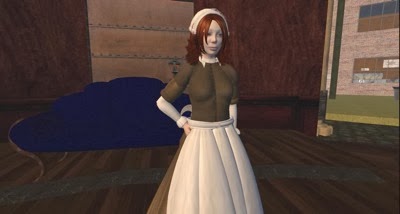 Miss Fargazer
She observed that the servant class was numerous - about 5% of the population of Wales in 1981, according to a survey - and mainly female (96%) inside the house, and often young, between the ages of 10 and 15. Most of the servants were in great houses, which had an entire hierarchy of servants, ranging from the Land Steward and House Steward, to the Upper Staff, which consisted of the Butler, Housekeeper, Cook, Lady’s Maid, and Valet, to the Lower Staff, including Footmen, Chamber Maids, Parlor Maids, House Maids, Between Maids, Kitchen Maids, and Scullery Maids. New servants were found through word-of-mouth, servant registries, or advertisements. After the initial position, a servant needed good references for subsequent positions.
In contrast, the middle class households generally had a single servant, a maid-of-all-work. More affluent households would perhaps have a cook or nursemaid. A maid-of-all-work might be a young girl from a workhouse, but in any event would have a staggering variety of work to do, from morning until evening.
As a personal observation, the variety of inexpensive labor-saving devices available today not only reduces the call for this kind of labor, but reduces the burden on the lower class. One does not have to be affluent to afford a washer and dryer, for example, or access to a laundromat. This is quite a Good Thing.
Thursday, November 14, 2013
Review: Doctor Who, "Dalek" and "Jubilee"
After watching “Dalek” recently, I listened to “Jubilee,” the Big Audio drama that inspired “Dalek,” the following day. The juxtaposition made for an interesting comparison.
In “Dalek,” the Ninth Doctor and Rose respond to a signal that takes them to the museum of a collector of alien artifacts. The prize of his collection is a damaged Dalek, a survivor of the Time War. The Dalek is kept in chains and tortured to talk, but it remains resolutely mute until it identifies the Doctor, at which point its instinct is to kill the Doctor. When Rose touches the Dalek, it absorbs her DNA, which both restores it to working order and corrupts it. After a rampage through the museum, killing almost everyone there, the Dalek finds that it can’t kill Rose and is ashamed of how it has developed this weakness. Lacking orders from a superior Dalek, it asks Rose to order it to self-destruct. She does so.
In “Jubilee,” the Sixth Doctor and Evelyn Smythe land initially in England in 1903, though the TARDIS won’t stay there. Ultimately, the two are left a century later, in an England that has fought the Daleks in 1903 and, with the help of the Doctor and Evelyn, won. (They have no memory of it, however, suggesting the 1903 events may take place in their future.) However, this England is a fascist empire with a cruel President. The President has a damaged Dalek, captured in 1903 by the current President’s great-grandfather. That Dalek, like the one in the TV episode, won’t speak even under torture. Also like the TV episode, the Dalek has had no orders from its superiors for a long time. As it is a soldier Dalek, it can only obey orders, not give them, and the lack of instructions has driven it mad. The President, to commemorate the 100th anniversary of the defeat of the Daleks, plans to execute the last one publicly. At the same time, the President’s wife has hatched a plan to kill her husband and, with the help of the Dalek, rule in his place. The events of 1903 begin bleeding into the present day, leading to a full Dalek battle fleet arriving in England. The damaged Dalek, despite new orders from the Dalek Supreme, is unwilling to kill Evelyn, the only human to have shown it mercy. When the other Daleks eventually kill it, the corrupted time line collapses.
While the TV episode focused on how Rose’s DNA caused the Dalek to mutate in a way that it found unacceptable, the audio drama was more interested in the question of free will (as well as showing how the Daleks’ motivation to extinguish all other forms of life was ultimately pointless, as a culture attuned to conquest would always be looking for the next conquest, even if it had to do so among its own people - the English Empire illustrated that).
Filming “Jubilee” with the Ninth Doctor and Rose would have been impossible in a single episode, so I understand why they drastically re-wrote the plot. Yet the extra time available for the audio drama and the freedom from having to appeal to children as well as adults created the freedom to explore issues in a deeper way. Ultimately, the issue of free will among soldiers is the more interesting one.
Tuesday, November 12, 2013
Into the Well
Loki Eliot, one of New Babbage’s long-time urchins and the creator of several interactive mysteries that take place within New Babbage under the umbrella title of the Babbage Chronicles, has a new eerie adventure called The Well: Sollicitus. It is a sequel to The Well from 2012.
In the original adventure,

The tunnels are tight and claustrophobic, containing branches on each level. Adding to the atmosphere, the tunnels contain small, shadowy creatures. Avoid them, as touching one flashes an unsettling image on your display and reduces your level of “sanity.” Run out of sanity, and you restart the game.
The experience requires a HUD for the modest sum of $L100. The HUD serves several functions: providing narration at key points, teleporting you to different points in the tunnels, providing the choices the monsters offer, and monitoring the level of “sanity."
Through some good luck, it didn’t take me all that long to complete the game, so it’s not a huge commitment of time. I found it fairly creepy, and keeping an eye on the “sanity” level added to the tension. My one suggestion for the next adventure is that the choices be related to clues you pick up along the way. As it was, the choices seemed fairly arbitrary. That’s a small quibble, however, in what was an exciting game.
The adventure starts here.
In the original adventure,
The idea is that a boy fell down a well, a rescue team was sent down rescue the boy but have not been heard of since. You then must go down and find out what has happened. You find a walkie talkie and communicate with a lone survivor of the rescue team who sort of guides you through the tunnels.This time,
The story is that a year after the events of last 2012, a team of scientific investigators are sent down the well to understand the caves strange geology and maybe find a clue to why the rescue team and a young boy disappeared with no trace. You arrive a day later than the rest of the team to find the make shift lab abandoned.You explore the caves, encountering what may be the spirit of the young boy, who provides you with information. Your role is to find three monsters, “defeating” each of them by choosing the correct image out of three offered. Choose correctly, and you find yourself teleported closer to your goal; choose incorrectly, and you find yourself back at the top of the well.
The tunnels are tight and claustrophobic, containing branches on each level. Adding to the atmosphere, the tunnels contain small, shadowy creatures. Avoid them, as touching one flashes an unsettling image on your display and reduces your level of “sanity.” Run out of sanity, and you restart the game.
The experience requires a HUD for the modest sum of $L100. The HUD serves several functions: providing narration at key points, teleporting you to different points in the tunnels, providing the choices the monsters offer, and monitoring the level of “sanity."
Through some good luck, it didn’t take me all that long to complete the game, so it’s not a huge commitment of time. I found it fairly creepy, and keeping an eye on the “sanity” level added to the tension. My one suggestion for the next adventure is that the choices be related to clues you pick up along the way. As it was, the choices seemed fairly arbitrary. That’s a small quibble, however, in what was an exciting game.
The adventure starts here.
Subscribe to:
Posts (Atom)