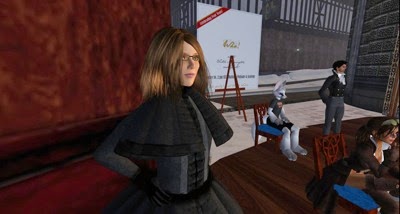
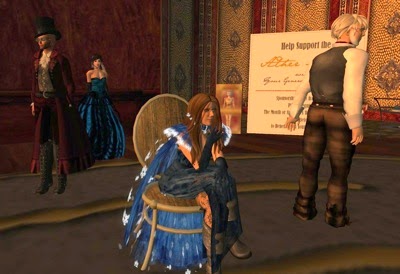
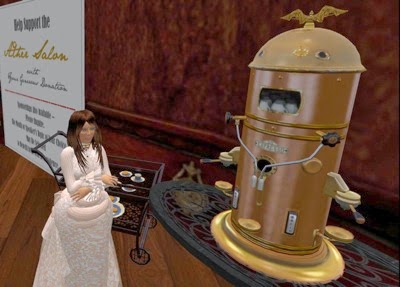
Showing posts with label Aether Salon. Show all posts

Monday, November 18, 2013

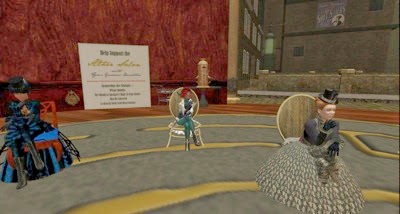
Aether Salon - Servants

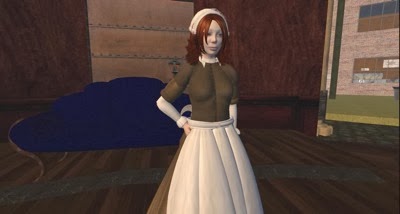
This month’s Aether Salon saw a talk on the topic of servants by Miss Lisa Fargazer. Miss Fargazer currently holds the position of maid-of-all-work at the Murgam Asylum and demonstrated a great deal of knowledge about the types of positions and types of work available to a servant in the late 19th century.

Aether Salon  Servants 001Miss Fargazer

She observed that the servant class was numerous - about 5% of the population of Wales in 1981, according to a survey - and mainly female (96%) inside the house, and often young, between the ages of 10 and 15. Most of the servants were in great houses, which had an entire hierarchy of servants, ranging from the Land Steward and House Steward, to the Upper Staff, which consisted of the Butler, Housekeeper, Cook, Lady’s Maid, and Valet, to the Lower Staff, including Footmen, Chamber Maids, Parlor Maids, House Maids, Between Maids, Kitchen Maids, and Scullery Maids. New servants were found through word-of-mouth, servant registries, or advertisements. After the initial position, a servant needed good references for subsequent positions.

In contrast, the middle class households generally had a single servant, a maid-of-all-work. More affluent households would perhaps have a cook or nursemaid. A maid-of-all-work might be a young girl from a workhouse, but in any event would have a staggering variety of work to do, from morning until evening.

As a personal observation, the variety of inexpensive labor-saving devices available today not only reduces the call for this kind of labor, but reduces the burden on the lower class. One does not have to be affluent to afford a washer and dryer, for example, or access to a laundromat. This is quite a Good Thing.

Wednesday, April 24, 2013

Aether Salon - Steamwave

April's Aether Salon brought Miss Emilly Orr to New Babbage to discuss Steampunk music - "Steamwave," in her term. Miss Orr's blog has long discussed Steampunk music, among many topics, both Second Life-related and related to her excursions around the Aetherwebs.

Miss Orr spoke broadly of Steamwave, describing it, in part, as "mak[ing] art that is fiercely individual." She pointed to a group, Steam Powered Giraffe, as a prototypical Steamwave band. Later, she observed that the kind of music that fell into the category was fluid, including musicians who incorporated rap into their songs, such as Professor Elemental, Mr. B, the Gentleman Rhymer, and the Desert Rose Theatre (in their takeoff of "Baby Got Back," entitled "Lady Has Bustle").

Unfortunately, about three-quarter of the way through Miss Orr's talk, I fell into a swoon - too much absinthe too early in the day, I fear - and missed the end. [Or the typist opened one program too far and Firestorm crashed. Take your pick.] Nonetheless, the entire talk is available at the Aetheric site of the Aether Salon.

Aether Salon  Steamwave 4 21 13 001
Miss Orr

Aether Salon  Steamwave 4 21 13 006
Baron Klaus Wulfenbach with Miss Orr

Aether Salon  Steamwave 4 21 13 002
Some of the attendees. Though the Salon looks sparsely populated in these pictures, at one point the two Babbage sims had 29 residents, all at the Salon.

Aether Salon  Steamwave 4 21 13 003


Aether Salon  Steamwave 4 21 13 004


Aether Salon  Steamwave 4 21 13 005

Friday, March 22, 2013

Aether Salon - Kinder!

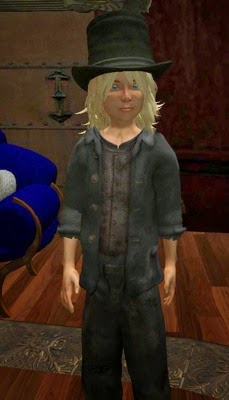
For this month's Salon, two young people, Master Jimmy Branagh of New Babbage and Miss Zaida Gearbox of Steelhead, presented their experiences as children in the Steamlands.

Aether Salon  Kinder 001

Aether Salon  Kinder 002
Jimmy Branagh

Aether Salon  Kinder 003
Zaida Gearbox

While the urchin culture in Babbage is somewhat grittier than that of the scamps in Steelhead, Jimmy observed that the urchins have become tamer over the years. He wondered whether this was entirely a good thing.

Aether Salon  Kinder 004

The crowd, as can be seen in the pictures, included many young people, though adults were also well-represented.

Aether Salon  Kinder 005

The presentations elicited a number of questions from the audience, along with predictable jeers from some of the young people in the crowd. Poor Miss Zaida, in particular, came under some criticism from one of her young friends for dressing nicely. This correspondent observes that she looked like a young lady, and found that quite refreshing.

Aether Salon  Kinder 006

The complete transcript may be found at the Aether Salon's aetheric presence.

Wednesday, February 20, 2013

Aether Salon - Siam

Admiral Invertigo Caldwell, of Steeltopia, was the speaker for February's Aether Salon, discussing some of the wonders of Siam, in Bangkok, Wat Pho, and the Grand Palace.

Aether Salon  Siam 001
Baron Klaus Wulfenbach introduces the speaker


Aether Salon  Siam 002
Admiral Caldwell reflects before he begins his talk

Aether Salon  Siam 006
I take my usual seat

Aether Salon  Siam 005
A small but enthusiastic and engaged crowd listens

Aether Salon  Siam 003
Pictures!

Aether Salon  Siam 004
A very big Buddah

The full transcript, as always, is available at the Aether Salon's aetheric location.

Saturday, January 26, 2013

Aether Salon - LEA

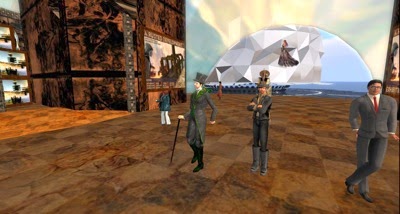
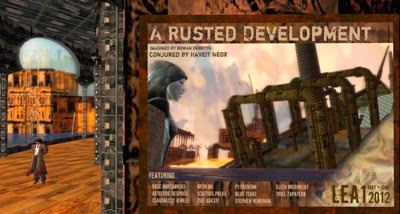
This month's Aether Salon featured a field trip! Dr. Rowan Derryth led the Salon in a tour of a new exhibit sponsored by the Linden Endowment for the Arts, entitled "A Rusted Development."

Aether Salon  LEA 001
Rowan Derryth

Aether Salon  LEA 002
The audience gathers

Aether Salon  LEA 003
A billboard for the exhibit

Aether Salon  LEA 004
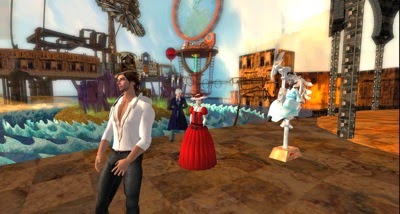
More of the audience
Aether Salon  LEA 005
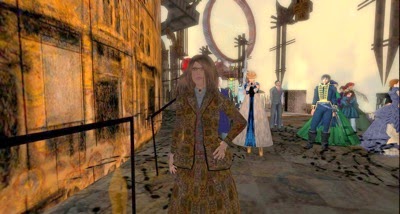
Still others in attendance 

Miss Bookworm Hienrichs introduced the speaker: "Rowan Derryth is the virtual persona of an actual art & design historian based in the UK. She writes regularly on virtual art in Second Life in her column ‘Ekphrasis’, available on the Prim Perfect blog. She is also the Curator for Avalon Arts Community, is a judge for the University of Western Australia (UWA) 3D Art Challenge, and is currently an advisor for the Linden Endowment for the Arts (LEA). She has spoken at the Aether Salon before, regaling us in November of 2010 with a wonderful discussion of Aestheticism. Welcome, Rowan!"
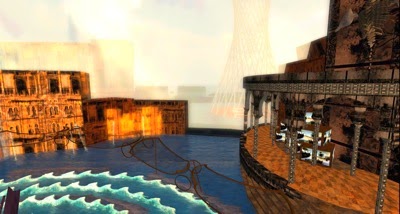
Aether Salon  LEA 006

Dr. Derryth replied, "I’d like to thank you all for escaping the relative safety of New Babbage today, to take part on this little field trip adventure to our abandoned city here. I do think our journey should be relatively safe though... I mean, what could possibly go wrong? Actually, this talk/visit will be a bit different because I’ll be talking about this in a mostly ‘OOC’ manner. While many artists here take on virtual personas, we do consider the art that is made here ‘real’, even it cannot be touched. So what I thought we could do is I’ll briefly explain a bit about how this exhibit came to be, then we will do a quick whistle-stop tour down to PJ’s lovely underwater gallery where we can pause and I’ll tell you a little bit about the LEA, then have a question-answer session….I do not fully participate in the Steampunk communities - although as many of you know I like to ‘dip my boot in’ - but it is an aesthetic I very much enjoy.... These themes relate to my academic research interests in 19th century art and design (some of which I’ve talked about at previous Salons and events), alongside those of urban renewal, and dystopic/utopic narratives. As such, I envisioned an installation where there exists a main build – a ‘development’ – that had fallen into ruin. It is subsequently rescued and repopulated by a selection of artists whose work loosely embraces similar themes. I knew I wanted to curate a group show, and I loved the idea of a kind of abandoned space that could be occupied, populated even, by some of my favourite artists. …. It is also a credit to Haveit [Neox] that some of the very finest jumped at the chance to be part of this work. Our ‘Rusted Artists’ are an impressive list: Rose Borchovski, Artistide Despres, Claudia222 Jewell, Bryn Oh, Scottius Polke, Ziki Questi, PJ Trenton, Blue Tsuki, Stephen Venkman, Eliza Wierwight, and Trill Zapatero."

Mr. Neox was introduced. He said, "Rowan Derryth truly surprised me with an invitation to build a sim for an exhibit. Her idea was to present a rusted environment that spoke of an abandoned city: a place where artists would come to revitalize it. I was immediately hooked by the idea and very excited because a passion of mine is constructing cities. Expanding on Rowan’s premise, I wrote a background story to give it a history. The fabled merchant city that rode atop the back of a gigantic whale met with a calamity that ended its existence abruptly. In the middle of the ocean, a horrific storm caused two huge ships carrying toxic chemicals to collide into the swimming whale city. The whale and all the populace died in the flood of chemicals that saturated the waves. The whale turned to bones, and the city to rust, it was nearly half a century before this city adrift was discovered. An expedition of artists, searching for land to build an art colony, came upon the decomposing city. With the intent to regenerate the place, they set to work by first towing to safe harbor the floating mass. Each artist then undertook their vision. The empty shell of the city suddenly filled in and expanded as each artist found their niche in the Rusted Development. No longer at the mercy of invisibility, the city humbles its rusted façade to the highlights of the art within."

Dr. Derryth again: "So basically all the artists were given the theme idea, then left to make whatever they like. When Haveit had the build largely done, they came over and scouted for spots to put their work. It was definitely a challenge, but they group worked beautifully together. I think the result is a bit chaotic, but in a way that really works for our idea."

We saw a few pieces of the exhibit: Scottius Polke’s ‘Eden Oxide’, Eliza Wierwight's 'A Fractured Fairytale,' and PJ Trenton's exhibit, 'Sunken Treasure,' consisting, as he said, of "images of places that are no longer around...lost as the inhabitants of the city were."

Aether Salon  LEA 007

Aether Salon  LEA 008

Aether Salon  LEA 009

Aether Salon  LEA 010

I did not have enough time to explore the exhibit (and the lag was a formidable obstacle in any event!), so I will be sure to return.
Tuesday, December 18, 2012
Aether Salon - Who!

December's Aether Salon brought Mr. Vic Mornington to discuss Doctor Who roleplay in Second Life.

In a first for the Salon, Mr. Mornington said his piece in Voice, which worked very well to keep the narrative moving along - I hope some future speakers choose this option.

He noted that several thousand people are SL Doctor Who roleplayers, a startlingly high number, with a variety of TARDIS interiors and exteriors.

Aether Salon  Who 001
Mr. Mornington displays a picture of a Steampunk TARDIS console.

Aether Salon  Who 002
A low-prim TARDIS console.

Aether Salon  Who 003
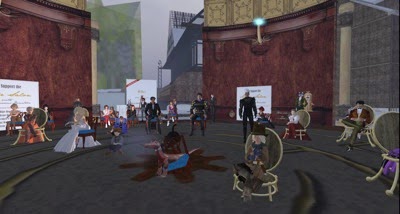
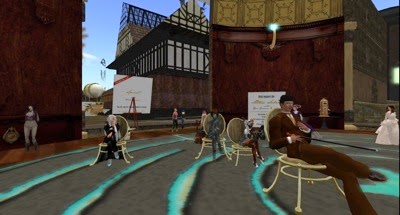
Some of the 40-plus Salonistas gathered.

Aether Salon  Who 004
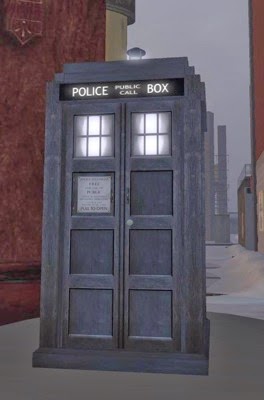
The traditional police box TARDIS.

Aether Salon  Who 005
I bundle up against the cold.

 A fascinating and very different talk from one of the fixtures of New Babbage.

As always, the full talk will be available at the Aether Salon's aetheric site.

Tuesday, November 20, 2012

Aether Salon - Literature

This month, the Aether Salon presented Dame Kghia Gherardi, who spoke on the origins of Steampunk Literature.

Aether Salon  Literature 11 18 12 005
Dame Kghia Gherardi

Dame Kghia noted that author KW Jeter coined the term in 1987, describing the genre as "Victorian fantasies." She continued:
From artist John Coulthart, we get this explanation: STEAMPUNK = Mad Scientist Inventor [invention (steam x airship or metal man/baroque stylings) x (pseudo) Victorian setting] + progressive or reactionary politics x adventure plot…. 
Steampunk has always been first and foremost a literary genre, or [at] least a sub-genre of science fiction and fantasy that includes social or technological aspects of the 19th century (the steam) usually with some deconstruction of, reimagining of, rebellion against part of it (the punk)…. 
Here is perhaps one of my favorites from author Beth Bernobich:  Steampunk is...a mood (fog-laden streets lined with cobblestones); a theme (a world standing on the edge between one age and the next), a tech level (horses and automobiles, clockwork creations, goggles and steam engines, and aircraft rising toward the stars), and more than a bit of madness…. 
Other definitions: 
Steampunk is...the love child of Hot Topic and a BBC costume drama.
~Gail Carriger, author of The Parasol Protectorate series 
Steampunk is what happens when goths discover brown. ~ Jess Nevins, author of Encyclopedia of Fantastic Victoriana 
That said, I think Jeff VanderMeer and SJ Chambers has given us perhaps the most workable framework for steampunk literature today. And if you are trying to decide of a work falls into this category, this definition may help. First, it’s simultaneously retro and forward-looking in nature. Second, it evokes a sense of adventure and discovery. Third, it embraces divergent and extinct technologies as a way of talking about the future.
Dame Kghia provided a list of novels in the genre, under various categories:

"Proto-Steampunk" novels:
  • Mary Shelley, Frankenstein (1818)
  • Jules Verne, 20,000 Leagues Under the Sea (1870) and The Steam House (188)
  • HG Wells, The Time Machine (1895) and Men Like Gods (1923)
Edisonade novels, targeted at boys and young men with the formula "a young American male invents a form of transportation and uses it to travel to uncivilized parts of the American frontier or the world, enrich himself, and punish the enemies of the United States.":
  • Edward Ellis, The Huge Hunter of the Steam Man of the Prairies (1865)
  • Henry Eaton, Frank Reade and His Steam Man of the Plain (1876)
  • Luis Senarens, Frank Reade, Jr. and His Steam Wonder (1879)
Precursors:
  • Ronald Clark, Queen Victoria's Bomb (1969)
  • Michael Moorcock, The Warlord of the Air (1971)
  • Harry Harrison, A Transatlantic Tunnel, Hurrah! (1972)
First Generation:
  • Tim Powers, The Anubis Gates (1983)
  • KW Jeter, Infernal Devices (1987)
  • Peter J Blaylock, Lord Kelvin's Machine (1992)
  • William Gibson and Bruce Sterling, The Difference Engine (1990)
Quiet Years: 1991-2007
  • Neal Stephenson, The Diamond Age: Or, a Lady's Illustrated Primer (1995)
  • Philip Pullman, The Golden Compass (1995)
  • Paul de Filippo, The Steampunk Trilogy (1995)
Supernatural:
  • Gail Carriger, The Parasol Protectorate
  • Cherie Priest, Boneshaker
  • Kim Newman, Anno Dracula
  • Clay Griffith, The Greyfriar
Mysteries & Detectives:
  • Lilith Saintcrow, The Iron Wyrm Affair
  • China Mieville, Perdido Street Station
  • Mark Hodder, The Strange Affair of Spring-Heeled Jack
  • PC Martin, Steampunk Holmes, Legacy of the Nautilus
  • T. Aaron Payton, The Constantine Affair
Westerns:
  • Cherie Priest, Dreadnought
  • Devon Monk, Dead Iron
  • MK Hobson, The Native Star
Airships & Pirates:
  • Chris Wooding, Retribution Falls
  • Michel R Vaillancourt, By Any Other Name
  • George Mann, The Affinity Bridge
  • Scott Westerfeld, The Manual of Aeronautics
Clockworks:
  • Ekaterina Sedia, The Alchemy of Stone
  • Jay Lake, Mainspring
  • Cory Doctorow, Clockwork Fagin
  • Kady Cross, The Girl in the Steel Corset
Colonial:
  • SM Stirling, The Peshawar Lancers
Anthologies:
  • Ann and Jeff VanderMeer, eds., Steampunk
  • Nick Geves, ed., Extraordinary Engines
  • Mike Ashley, Steampunk Prime: A Vintage Steampunk Reader
Graphic Novels:
  • Phil and Kaja Folio, Girl Genius
  • Sydney Padua, The Thrilling Adventures of Lovelace and Babbage
  • Brian Selznick, The Adventures of Hugo Cabret
  • Ian Edginton and D'Israeli, Scarlet Traces
  • Alan Moore, The League of Extraordinary Gentlemen
Reference Books:
  • Jeff VanderMeer with SJ Chambers, The Steampunk Bible
  • Jess Nevins and Michael Moorcock, The Encyclopedia of Fantastic Victoriana
Aether Salon  Literature 11 18 12 001
Miss Bookworm Hienrichs

Aether Salon  Literature 11 18 12 002
L to R: Mr. Emerson Lighthouse, Miss Violet Solano, Miss Garnet Psaltery, Miss Tephi Zepp, Miss Robin Ishmere, Sir JJ Drinkwater, Miss Hysshia ap Suolla an Isala

Aether Salon  Literature 11 18 12 003
L to R:  Mr. Guisborn, Miss Sidonie Ancelin, me, Mr. Kelso Uxlay

Aether Salon  Literature 11 18 12 006
L to R, from the foreground chair: Mr. Simeon Beresford, Miss Solace Fairlady, Miss Stereo Nacht, Mr. Kelso Uxlay, Miss Polly Ellsmere, Mr. Linus Lacome, Mr. Sebastian Nevermas, Mr. Satu Moreau, Miss Cassie Eldemas

Dame Kghia's talk made it clear that I - along with much of the audience, it appeared - have some reading to do!

Sunday, October 28, 2012

Aether Salon - Vampires!

The first Salon of the year featured a timely topic: vampires. Miss Angelia Rees spoke to the Salon on this topic, one very close to her. I present her remarks below; as always, the official transcripts are available at the Aether Salon blog.

We had a good-sized crowd, including Miss Bookworm Hienrichs, who, in the Baron's absence, introduced the speaker, Ceejay Writer, Linus Lacombe, Madame Anneli, Arnold, Cyan Rayna, Marion Questi, Darlingmonster Ember and Solace Fairlady, Nathan Adored, Wildstar Beaumont, Brother Lapis, Emerson Lighthouse, JJ Drinkwater and Serra, Carolx Hax, Random Wezzog, Vernden Jervil, Renee Caxton, Magda Haiku, Miss Sera, and Kghia Gherardi. Dame Kghia will be our speaker next month, on a topic near to my heart, Steampunk Literature.

I took a few pictures, but was thwarted by the sim's performance. After a half-dozen pictures, I noticed everyone slowing to a crawl, and dresses no longer moved. Sim statistics showed I was at lethal 3.4 frames per second, so I stood very, very still and hoped for the best.

Aether Salon  Vampire 001
 Miss Angelia Rees

Aether Salon  Vampire 002
 Miss Bookworm Hienrichs

Aether Salon  Vampire 003
Mr. Vernden Jervil and Miss Ceejay Writer

Aether Salon  Vampire 004
Standing very still

Aether Salon  Vampire 005
Arnold and Cyan Rayna (foreground)

Aether Salon  Vampire 006
A motley collection of Salonistas 

Angelia Rees:
Good afternoon! Welcome to the AEther Salon's presentation of "Vampires!", a discussion of the legend, history, and modern impact of the vampire. I am Angelia Rees - in RL a practising vampire of the sanguinarian type (more on that as we progress!) and well-studied in the myths and legends surrounding vampires and vampirism. My discussion today will begin with vampires in the ancient world, the impact of vampires and their legends on the modern era, and a brief look into the vampire sub-culture of which I am a part. At the end of my presentation, I will take questions from the audience (if you have any). And with that said, I think we can begin the presentation! 
The earliest legends of the vampire date back at least 4,000 years, to the ancient Assyrians and Babylonians of Mesopotamia. Mesopotamians feared Lamashtu, a demonic goddess (the daughter of sky god Anu) who preyed on humans. It was said that Lamashtu would creep into a house at night and steal or kill babies, either in their cribs or in the womb. Mesopotamians attributed sudden infant death syndrome and miscarriage to this figure. Lamashtu, which translates to "she who erases," would also prey on adults, sucking blood from young men and bringing disease, sterility and nightmares. She is often depicted with wings and birdlike talons, and sometimes with the head of a lion. To protect themselves from Lamashtu, pregnant women would wear amulets depicting Pazuzu, another demonic god who once defeated the goddess. Lamashtu is closely associated with Lilith (from the Akkadian root, lilu, meaning "spirit"), a prominent figure in Jewish texts who bears many similar traits and visual images. Accounts of Lilith vary considerably, but in the most notable versions of the story, she was the original woman. God created Adam and Lilith from the Earth, but there was soon trouble between them. Lilith refused to take a subservient position to Adam, since she came from the same place he did. In one ancient version of the legend, Lilith left Eden and began birthing her own children. God sent three angels to bring her back, and when she refused, they promised they would kill 100 of her children every day until she returned. Lilith in turn vowed to destroy human children. While she is often depicted as a terrifying creature, Lilith also had seductive qualities. The ancient Jews believed she would come to men at night as a succubus and drain them of both blood and semen. Accounts of Lilith as a child-killer seem to be taken directly from the Lamashtu legend. She is often described as a winged demoness with sharp talons, who came in the night, primarily to steal away infants and foetuses. Most likely, the Jews assimilated the figure of Lamashtu into their tradition, but it's also possible that both myths were inspired by a class of Akkadian demons known as lili (male) and lilitu (female), which were disease-bearing wind spirits. 
The ancient Greeks feared similar creatures, notably Lamia, (Aristophanes claimed her name derived from the Greek word for gullet: laimos), a demoness with the head and torso of a woman and the lower body of a snake. In one version of the legend, Lamia was one of Zeus' mortal lovers. Filled with anger and jealousy, Zeus' wife, the goddess Hera, made Lamia insane so she would eat all her children. Once Lamia realized what she had done, she became so vengeful that she began sucking the blood from young children out of jealousy for their mothers. Myths variously describe Lamia's monstrous serpentine appearance as a result of either Hera's wrath, the pain of grief, the madness that drove her to murder, or - in some rare versions - a natural result of being Hecate's daughter (as one of the Empusai). The Empusai were the malicious daughters of Hecate, the goddess of witchcraft. They could change form, and at night, came up from Hades (the underworld) as beautiful women. They would seduce shepherds in the field, and then devour them. 
Vampire-like figures also have a long history in the mythology of Asia. Indian folklore describes a number of nightmarish characters, including rakshasa, shape-shifters who preyed on children, and vetala, demons who would take possession of recently dead bodies to wreak havoc on the living. In Chinese folklore, corpses could sometimes rise from the grave and walk again. These beings were created when a person's p'o (lower spirit) did not pass onto the afterlife at death, usually because of bad deeds during life.
The p'o, angered by its horrible fate, would reanimate the body and attack the living at night. One particularly vicious sort of creature, known as the Kuang-shi, could fly and take different forms. The Kuang-shi was covered in white fur, had glowing red eyes and bit into its prey with sharp fangs to drain them of blood. Nomadic tribes and travelling traders spread different vampire legends throughout Asia, Europe and the Middle East. As these stories travelled, their various elements combined to form new vampire myths. In the past 500 years, vampire legends have been especially pervaded with Eastern European contributions. As I continue, we'll look at these creatures, the direct predecessors of the modern vampire. 
Vampires In The Modern Era 
The Dracula legend, and the modern vampire legend that came out of it, was directly inspired by the folklore of Eastern Europe. History records dozens of mythical vampire figures in this region, going back hundreds of years. These vampires all have their particular habits and characteristics, but most fall into one of two general categories: 1. Demons (or agents of the devil) that reanimated corpses so they could walk among the living, and 2. Spirits of dead people that would not leave their own body. The most notable demon vampires were the Russian upir and the Greek vrykolakas. In these traditions, sinners, unbaptised babies and other people outside the Christian faith were more likely to be reanimated after death. 
Those who practised witchcraft were particularly susceptible because they had already given their soul to the devil in life. Once the undead corpses rose from the grave, they would terrorize the community, feeding on the living. 
By many accounts, these undead corpses were required to return to their grave regularly to rest. When townspeople believed that someone had become a vampire, they would exhume the corpse and try to get rid of the evil spirit. They might try an exorcism ritual, but more often they would destroy the body. This might entail cremation, decapitation or driving a stake or spikes through various parts of the body. Bodies might also be buried face down, so the undead corpses would dig deeper into the earth, rather than up into shallower ground. Some families secured stakes above the corpse so it would impale itself if it tried to escape. 
The vampires in Moldavia, Wallachia and Transylvania (now Romania) were commonly called strigoi. Strigoi were almost exclusively human spirits who had returned from the dead. Unlike the upir or vrykolakas, the strigoi would pass through different stages after rising from the grave. Initially, a strigo might be an invisible poltergeist, tormenting its living family members by moving furniture and stealing food. After some time, it would become visible, looking just as the person did in life. Again, the strigo would return to its family, stealing cattle, begging for food and bringing disease. Strigoi would feed on humans, first their family members and then anyone else they happened to come across. In some accounts, the strigoi would suck their victims' blood directly from the heart. Initially, a strigo needed to return to the grave regularly, just like an upir. If townspeople suspected someone had become a strigo, they would exhume the body and burn it, decapitate it, or run spikes through it. But after seven years, if a strigo was still around, it could live wherever it pleased. It was said that strigoi would travel to distant towns to begin new lives as ordinary people, and that these secret vampires would meet with each other in weekly gatherings. 
In addition to undead strigoi, referred to as strigoi mort, people also feared living vampires, or strigoi viu. Strigoi viu were cursed living people who were doomed to become strigoi mort when they died. Babies born with abnormalities, such as a vestigial tail or born with a bit of foetal membrane tissue covering the head (called a caul), were usually considered strigoi viu. If a strigoi mort living among humans had any children, the offspring were cursed to become undead strigoi in the afterlife. When a known strigoi viu died, the family would destroy its body to ensure that it would not rise from the grave. 
In other parts of Eastern Europe, strigoi-type creatures were known as vampir, most likely a variation on the Russian upir. Western European countries eventually picked up on this name, and "vampyr" (later "vampire") entered the English language. 
In the 17th and 18th centuries, vampire hysteria spread through Eastern Europe. People reported seeing their dead relatives walking around, attacking the living. Authorities dug up scores of graves, burning and staking the corpses. Word of the vampire scare spread to Western Europe, leading to a slew of academic speculations on the creatures, as well as vampire poems and paintings. These works in turn inspired an Irishman named Bram Stoker to write his vampire novel, "Dracula." The original Dracula was a real person, Vlad III, Prince of Wallachia, who ruled in the mid 1400s. His father, Vlad II, was known as Vlad Dracul (translated as either "Vlad the dragon" or "Vlad the devil"), in recognition of his induction into a society called The Order of the Dragon. Vlad III was sometimes referred to as Vlad Draculea, meaning "son of Dracul," but more often he was called "Vlad Tepes," meaning "Vlad the Impaler." This was in reference to Vlad's predilection for impaling his enemies on long wooden stakes. The real Dracula had a reputation for unfathomable brutality (a reputation his actions against his enemies did nothing to amend), but there is not much evidence showing that people believed he was a vampire. Stoker's fictional villain is not closely modelled after the real Dracula, though they are sometimes linked in films based on the book. Mainly, Stoker borrowed the name of the prince, as well as his social standing. Unlike the wandering, homeless strigoi, Stoker's vampire was a wealthy aristocratic type, hiding out on a grandiose estate. It is from this novel, and the popular vampire genre that followed it, that we get most of our ideas about what vampires are today. They have become the "anti-hero", a figure of both danger and romance. 
Let's consider the modern vampire myth and what it offers: 1. Vampires are sexually attractive and charismatic. 2. They have superhuman intelligence and powers, such as the ability to fly and immense strength. They can use mind control and telepathy to get what they want. Vampires can also use their powers to enslave other creatures, such as wild animals to do their dirty work for them. 3. They inspire fear and no one crosses them without suffering dire consequences. 4. Vampires have conquered death and achieved immortality. The vampire myth is an interesting symbol which has evolved dramatically through literature and film. A great escape into a world that is thrilling, romantic, and mysterious, where real danger and evil is not always so apparent or frightening. The modern era has pulled the vampire's fangs, in a sense: the real fear and terror vampires once inspired has passed away into superstition, and been resurrected into an impotent but compelling media genre in little more than 100 years time. 
Modern Vampire Subculture: 
It's due to this new attractiveness that surrounds the vampire that inspired a new culture within modern society: the vampire subculture. What is a subculture? A subculture is simply an alternative lifestyle that exists within mainstream culture.  The vampire subculture is very "tribally" based, with many members congregated into small clans, usually called covens or houses. Each coven/house has it's own traditions and rules of vampiric behaviour (which may or may not include laws regarding the drinking of blood). There are also solitary vampires that belong to no group officially, but are still part of the subculture. Vampires within this subculture are normal people. They don't believe they are an immortal monster of any kind, but the metaphor and realities of the vampire speaks to them, expressing an emotional or physical truth about their lives and natures. They are not "vampire roleplayers", but actual human beings engaged in a lifestyle that includes vampiric activities. This is the only qualifier that separates vampires from Average Joe. It is not a "let's play pretend" society, but a community of people who share a common lifestyle. All vampires believe that the type of vampirism they engage in is both a necessary and important part of their lives. (This should not be confused with "vampire lifestylers", who dress up and emulate the Hollywood version of vampires, and who generally do not practice any form of actual vampirism.) Real vampirism and vampires also have nothing to do with clinical vampirism. Those that suffer from clinical vampirism, in most cases, are not real vampires. Clinical vampirism is a pathological and delusional disease, fetishistic and compulsive in nature, where a person experiences a psychological need for blood (sometimes with a strong sexual component). Generally, those that suffer from the syndrome often go through a progression of stages beginning with auto-vampirism (drinking one's own blood) and progressing to vampirism (drinking the blood of others). The compulsion of the vampirism stage may lead a person to committing criminal acts to obtain human blood, such as stealing blood from hospitals and blood banks or going to the extreme of killing someone. 
So what is a "real" vampire, then? The key factor in determining if one is a vampire is if one has a genuine need for life-force energies from outside sources. There are physical "symptoms" associated with being a vampire as well. Some of the physical traits are what might be expected: pale skin, sensitivity to sunlight physically (i.e., sunburn easily) and/or visually sensitive to any light source, better night vision than day vision, heightened senses, able to heal quicker than others. And some not so expected: feeling hungry and/or thirsty despite an adequate diet, frequent headaches for no apparent reason, not requiring very much sleep, getting sick with "flu-like" symptoms with no medical explanation when forced to go without feeding for a period of time. Real vampires are identifiable partly because they have a majority of these symptoms, not just one or two. But more significantly, real vampires are distinguished by a certain quality to their energy. While anyone reading a description of the symptoms might find a few that apply to people he knows, or even to himself, real vampires have a way of standing out vividly to everyone who interacts with them. Within the vampire subculture, active vampirism includes both sanguinarian vampirism, which involves blood consumption, and psychic vampirism, whose practitioners "feed" by drawing nourishment from auric/pranic, emotional, or sexual energy. Psychic vampires are also often energy mediums. An energy medium is a human being with an inborn ability to influence, channel, manipulate, and transform all types of energy, but in particular biological and aetheric energy, for either good or ill. Sanguinarian vampires are generally not mediums, but can possess a limited ability to manipulate the energy of those around them. The distinguishing characteristic of the sang vampire is the consumption of blood. And while the medium of exchange is blood, the purpose is the same - to replenish and enhance the vampire's energy levels. While some sanguinarians can also feed using a psychic method, many cannot, and those who can will often choose blood regardless, finding it a more satisfying "meal". 
The idea of transferring energy back and forth from person to person is not a new one. Many religions and belief systems hold true that every member of society shares their energy with others as they interact. Indeed, many people feel energized by being around others and by interacting with them. We relieve our stress and enhance our contentment in life by sharing our lives with those around us. The difference with vampires is that they generate less of that energy than others do and need more of that energy from others. If you have a person in your life whom you like, whom you enjoy being around, but despite that, being with them makes you feel drained, then that person may very well be a vampire. 
It should be noted that many sanguinarians define their condition as an objective, if unrecognised, medical syndrome, entirely biological in nature. They are hostile toward "spiritual" explanations for their blood craving, and many reject the idea that it has anything to do with energy. But whatever the reason, the need to consume blood is a very real physical need for sang vampires, with real physical consequences if that need is denied. That being said, sanguinarians seldom drink as much blood as often as they should for optimal health. The reasons for this include lack of sources, self-denial, and unawareness of their true nature and needs. The amount of blood consumed, and the frequency of consumption, varies, but few consume more than tiny amounts at a time, usually obtained through slight cuts or punctures made by sterile lancets or blades on willing human donors. Most sanguinarians insist that donors undergo testing for blood-borne diseases, including HIV and hepatitis. Some sanguinarians consume animal blood, but most consider it an inferior (or unacceptable) substitute for human blood. Whether sanguinarian or psychic, vampires come from all walks of life. Virtually every age, race, religion and profession is represented in the subculture. They are normal, regular people in normal regular jobs: teachers, lawyers, accountants, even soccer moms. They have normal lives but there is this issue of needing to take energy and/or blood from time to time and in certain ways. And while many teenagers are drawn to the subculture, they are often kept humanely on the fringes, and sometimes actively discouraged. This is both for the protection of the community (who cannot afford misunderstandings involving minors) and for the best interest of the teens: many teenagers who self-identify as part of the vampire subculture eventually grow out of it. Mature vampires understand this as a normal part of being a teen and struggling to find who you are. As such, young people generally are not fully embraced into the community until they reach maturity. 
Conclusion: 
While this lecture has only barely scratched the surface of the myths, legends, and realities of the vampire (and there is so much more to learn that a short discussion can never do it justice), I hope it has inspired you to inquire further on your own. The myth of the vampire has influenced human culture, belief, and behaviour since the beginning of our civilisation. It has served as an explanation for the unexplainable, a cautionary tale, and even a desirable exemplar. The vampire haunts our darkest fears, inspires our wildest dreams, and forces us to probe our own psyches about what it means to be human. In a way, we all have a bit of the vampire inside us, showing us our reflection through a mirror darkly - both what we hope and fear to become. And whether we embrace the darkness inside us, reject it utterly, or make a truce, it is always with us. Immortal, eternal, and endless. 
Thank you for inviting me to speak today, and I hope you enjoyed my presentation. If you have any questions, I'd be pleased to address them now. ㋡\

Thursday, May 24, 2012

Aether Salon - Spirits!

For the last Salon of the season, Baron Wulfenbach invited Jarl Otenth Paderborn to discuss the subject of spirituality and religion in Second Life.

 The Jarl talked a little about his own path into Second Life, first seeking fellow Quakers and then becoming involved with the Unitarians, before discussing other spiritual centers of the virtual world.


Aether Salon  Spirit 001
Baron Klaus Wulfenbach and Jarl Otenth Paderborn


Aether Salon  Spirit 002
I try to figure out how to operate the coffee machine


Aether Salon  Spirit 003
Some of the Salon attendees


Aether Salon  Spirit 004
Ladies Solace Fairlady and Darlingmonster Ember, with Mr. Linus Lacombe


Aether Salon  Spirit 005
Miss Gabrielle Anatra, Miss Bookworm Hienrichs, Miss Sidonie Ancelin, and Miss Nika Thought-werk (a clockwork being)


Aether Salon  Spirit 006
Admiral Wildstar Beaumont


Aether Salon  Spirit 007
Clockwinder Mosseveno Tenk, with Mrs. Holmes (!) in the background


Aether Salon  Spirit 008
Miss Belle Milneaux (background) and Dame Kghia Gherardi (foreground)


Additional pictures, from Miss Hienrichs, are available here. A complete transcript of the even is available at the Salon's Aetheric Pages.