Tuesday, July 30, 2013

Review: Doctor Who, "Phobos" and "No More Lies"

Two more stories in the first season of adventures with the Eighth Doctor and Lucie Miller. "Phobos" is set on the Martian moon of the same name - transformed into an adventure park for "Drennies" - adrenaline junkies, into extreme sports. Visitors can take part in activities such as the "Wormhole" - a vertical tunnel, apparently bottomless, to jump down with a bungie cord of arbitrary length.

Lodge keeper Kai Tobias claims that the Wormhole has monsters in it. No one believes him until one of the guests is wounded. The Doctor and Lucie investigate...

Unusually for the Big Finish audio productions I've heard so far, at times I found it difficult to distinguish the voices of some of the women, especially Amy and Eris. Two of the visitors, Drew and Hayd, are young adventurers (and obviously gay). I found their California surfer dude talk to be somewhat irritating.

Although the story started out slowly, it picked up steam and had several late twists in the plot. The story also had some characteristically witty dialogue. For example:
Lucie: "What does it want?"
Doctor: "I think it wants to kill us."
Lucie: "Simple as that?"
Doctor: "You can't overcomplicate these things some times."
At one point, Lucie says to the Doctor, "Maybe you're scarier than the monsters." She's getting to know him better.

In "No More Lies," Lucie and the Doctor fail to stop Nick Zimmerman from stealing time travel technology and are left for dead, barely escaping the Tar-Modowk - creatures that live in the time vortex. They track Zimmerman, only to find him at a garden party looking some 30 years older. Soon it becomes clear that the TARDIS has landed in a time loop, and the Tar-Modowk aren't far behind...

At the garden party, the Doctor meets Zimmerman again while Lucie spends some time with Zimmerman's wife, Rachel. The Doctor must find out who created the time loop, and why, as well as what happened to the time-travel technology that Zimmerman stole.

The monsters in this story are almost a distraction - the focus is on Zimmerman and his relationship with his wife. Did he change from a baddie when he fell in love with Rachel? Why the time loop?
One thing that struck me, however: if you're stuck in a time loop do you really experience time passing? Doesn't the passing of 30 years seem only like the duration of the loop to you, rather than 30 years?

The story was solid and the resolution satisfying.

At the end of the story, the mysterious Headhunter, who has been chasing Lucie throughout the season, reappears. This sets up the season finale and resolution of the "Who is Lucie Miller?" story arc.

Friday, July 26, 2013

Review: Doctor Who, "The Dalek Contract" and "The Final Phase"

The final two episodes of the Fourth Doctor's adventures with Romana on Big Finish's audio dramas constitute a two-part story that picks up where "The Sands of Life" and its sequel "The War Against the Laan" left off.

In "The Dalek Contract,"
The Doctor and Romana [and K9] find themselves in the Proxima System, where enigmatic Conglomerate CEO Cuthbert [David Warner, the professor in TV's "Cold War" episode] has been conducting his infamous 'experiment'. An experiment which might accidentally rip the universe apart.
Of course, it's no accident that the TARDIS arrived where it did: the Doctor once again turned off the Randomizer. Romana asks him, "Do you have a death wish?" But of course the Doctor has method in his madness, as he is concerned that Cuthbert's experiments have unleashed something very dangerous.

On Proxima Major, instead of a temperate climate the Doctor and Romana find a freezing planet - and a whole lot of people very unhappy about that fact. They (correctly) blame Cuthbert for moving the planet out of its orbit and they (incorrectly) believe that the Doctor and Romana are working for Cuthbert. Meanwhile, the resistance group has a bigger problem: Daleks.

It seems that Cuthbert's effort to subdue the local population involved a contract with the Daleks to provide a security force for him. Cuthbert seems to think the Daleks won't double-cross him because he has a contract with them. It does seem a bit unlikely that anyone aware of the Daleks would think this is a good idea.

As an aside, the name of Cuthbert's assistant, Mr. Dorrick (played by Toby Hadoke) sounds too much like "Mr. Dalek" - something unfortunate in a story with Daleks.

"The Final Phase" continues the story, pitting Cuthbert's ruthless interest against the Proxima System's freedom-fighting population as Cuthbert's plan begins to come to fruition. What is he interested in such that he would be willing to rip a hole in the universe? And what are the Daleks really up to? And what do they need from Cuthbert badly enough to pretend to be working for him?

Despite a fair amount of arm-waving when it comes to having the science make sense, these stories have been a pleasure to listen to. Warner's Cuthbert is a wily, snarky businessman, not particularly evil but used to getting his way and willing to do whatever it takes to make that happen. Tom Baker  doesn't seem to take things too seriously, having a chuckle in his voice throughout the production, even as his Doctor engages in his usual derring-do and plunges into life-threatening situations. Mary Tamm has just the right amount of icy detachment and exasperation in her voice, as though the situations she finds herself are somehow just a little beneath her dignity, even as she finds herself admitting that she has started enjoying the Doctor's company.

Among the pleasures of these stories are the small asides. For example, it turns out K9 has a "stealth mode," allowing him to move quietly when the situation requires. Romana asks, "Why didn't you ever do that before?" K9: "No one ever asked, Mistress." Indeed.

I look forward to next season's Fourth Doctor adventures, which will re-unite him with Leela.

Monday, July 22, 2013

Victorian Fantasy: William Butler Yeats

This month's meeting of the Victorian Fantasy discussion group looked at three early poems by Irish poet William Butler Yeats: "The Hosting of the Sidhe," "The Stolen Child," and "The Song of Wandering Aengus." All were written in the last decades of the 19th century: 1893, 1886, and circa 1893, respectively.

Much of the discussion focused on Yeat's mining of Irish folklore - tales of faeries, in particular - in his poems, creating an undeniable Irishness about them. Sir JJ Drinkwater (thankfully not invisible to me this time around) observed that Yeats wrote in English rather than Gaelic - perhaps merely a nod to his greater familiarity with the former language, but also perhaps to make a point to the English, who were still occupying Ireland at the time, of the continued existence of Irish culture, including its folklore and literature.

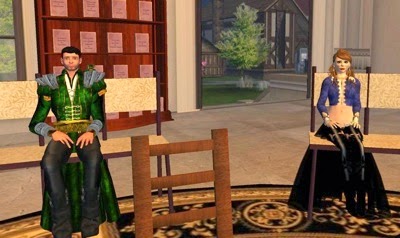
Victoria Literature  Yeats 001
Miss Herndon Bluebird, Miss Ludo Merit, your humble scribe, Mr. Terence Tyromancy

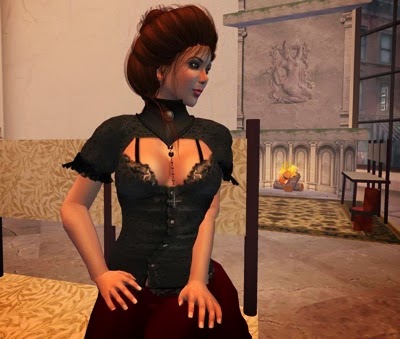
Victoria Literature  Yeats 002
Sir JJ Drinkwater, Miss Ellie Mink

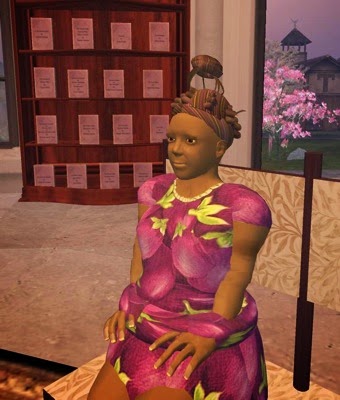
Victoria Literature  Yeats 003
Miss Nadienne, Mr. Hamish Blackbear, Miss Leana Sidhe

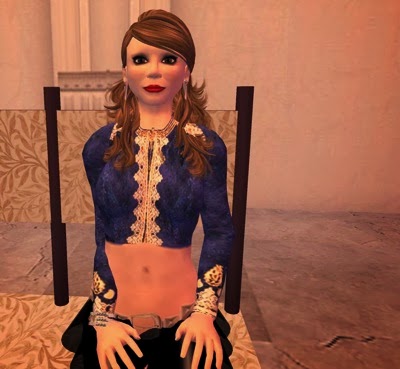
Victoria Literature  Yeats 005
Mrs. Cassie Writer-Eldemar and Mr. Oldesoul Eldemar

Victoria Literature  Yeats 006
Dame Kghia Gherardi

Next month's discussion involves William Morris's 1897 novel The Water of the Wondrous Isles, described in Wikipedia as "perhaps the first modern fantasy writer to unite an imaginary world with the element of the supernatural, and thus the precursor of much of present-day fantasy literature." (Wikipedia also says the novel is 340 pages, so I'd better begin now!)

Thursday, July 18, 2013

Gwen

I like to walk through the streets and alleyways of New Babbage, observing the everyday going-on of the populace, talking to the merchants and tinkerers, urchins and villains. The rougher parts of town, such as the Gut, require some care to navigate safely, but an observant eye, a quick step, and several concealed weapons help immensely.

On the surface, Babbage is filled with respectable citizens, going about their business in a (mostly) law-abiding manner. Nearly everyone has experienced the antics of the urchins and is aware of the roguish pirates who oil the cogs of commerce, but they avoid the hidden corners where the underclass lives and plies trades of a less-respectable nature. From a lady of the night to a murder for hire, everything is for sale to those who know where to look.

At first, the prostitutes would occasionally mistake me for a potential customer: at night, wearing a cape that covers my head, and walking where no respectable lady should be, I could understand being mistaken for a boy. As I would approach and my face and skirts became visible, reactions would range from disappointment - more long hours out in the cold and dark would be necessary before retiring to a warm bed - to relief. In fact, once they overcame their initial suspicion of a female stranger with a foreign accent starting a conversation, many of the women seemed grateful for a hot tea - I always carried some with me for this purpose - and a the temporary distraction from their duties.

Although I became acquainted with many of the ladies who plied their trade on the streets, I became closest to Gwen. Gwen Smith, she styled herself, and it's even possible that she was born with one or both of those names. She had a weather-beaten face and appeared at first glance to be in her early forties, though closer inspection suggested her true age was perhaps twenty years younger. She had kind eyes, which surely helped her attract customers, but those eyes also contained a great deal of sadness. She confided in me that her mother, widowed at an early age and never remarried, had no further use for Gwen when she turned sixteen. Gwen was forced to leave, with little money, no learned trade, and no romantic prospects. Little wonder that Gwen's path eventually took her to the alleyways of Babbage to earn a living. The surprise was that, despite her experiences, she maintained a positive attitude toward mankind.

"Oy, Rhianon, the weather has been something awful this past winter. It's an omen, I tell you, an omen of troubled times to come to Babbage."

"Come now, Gwen. That's nothing but superstition, and you know better than that."

Gwen shook her head. "Nay. The old ways don't seem 'tall scientific, not in this age of mechanical wonders of ours, but our ancestors knew what they was doing right enough. Bad weather means bad times ahead. And that's not all - I heard of strange creatures found yonder in the Fells, huge worm-like things. As sure as my name is Gwen Smith, that means a stranger in town will be the cause of the bad times." She crossed her arms, daring me to contradict her.

I laughed. "I won't discount what you say. This is New Babbage, after all, and the town seems to live on a diet of strange happenings."

Two unkempt boys ran toward us, both about thirteen years old. I recognized them as part of the ever-shifting population of urchins, but couldn't recall names. The one on the left waved some coins. "Miss Gwen, I got two dollars. How about you and me getting dirty together?"

Gwen tousled his hair and gave him a friendly push on his way. "You know well that two dollars won't pay for any time in me bed, Samuel. Any road, you seem plenty dirty already, by the looks of you."

The other boy waved a single coin. "How 'bout a look under your skirt, then, Miss Gwen?"

"Ahhh, away with boths of you." She swatted the air where the second boy had stood, but both were on their way, running down the alley again, laughing. "Boys," she said to me, "too young to know you always pay for what you get, one way or t'other, and the price is never cheap." She looked sad for a moment, a far-away expression in her eyes.

Sunday, July 14, 2013

Review: Doctor Who, "The Horror of Glam Rock" and "Immortal Beloved"

"The Horror of Glam Rock," the third outing for the Eighth Doctor and Lucie Miller (following the two-part "Blood of the Daleks") and released in March 2007, is set along a motorway on Earth in 1974 - the closest the Doctor is allowed to get to Lucie's own time. The title, of course, is a play on the Fourth Doctor story "The Horror of Fang Rock," and plays up the glam era.

Trapped in a diner along the motorway along with the Doctor and Lucie is manager Arnold Korns (Bernard Cribbins - Wilfred Mott from the television series) and his latest proteges, Tommy and Trisha Tomorrow… as well as Lucie's Aunt Pat who, in 1974, has no niece. Tommy Tomorrow has inadvertently summoned hungry aliens, and the group in the diner must find a way to send the aliens away again.

The story was a slight one, with surprisingly little tension, despite one horrific death and several other characters in peril. In fact, surprisingly little is made of the glam rock era, other than some references to various musicians (the Doctor name-drops Brian Eno) and the use of period music. Mainly this is a "base under siege" story that could be set anywhere.

The next story in the series, "Immortal Beloved," from April 2007, is a meatier story. When the Doctor and Lucie land on what appears two be a Grecian hilltop, they find two lovers, Kalkin and Sarati, about to kill themselves by throwing themselves off the cliff, rather than live the lives for which they have been raised. The Doctor intervenes, allowing General Ares to arrive in a helicopter to take the pair with him. Instead, Kalkin shoots Ares, who is tended to by the Doctor.

When the group returns to a palace, the Doctor and Lucie encounter rulers Zeus (Ian McNeice, later Winston Churchill in the TV series, and the wonderful newsreader in the series Rome) and Hera (Elspet Gray, Time Lady Thalia in "Arc of Infinity" from the classic TV series), and Tayden, a young man to whom Lucie takes a fancy. Lucie is horrified when Hera operates machinery to transfer Ares' mind from his dying body to that of Tayden - a clone, raised for just such a purpose. Kalkin is a clone of Zeus (as indeed is young Ganymede, played by Paul McGann's son Jake), while Sarati is Hera's clone. The ruling class are all survivors of a spaceship crash over a thousand years ago. With the use of a succession of clones, they have maintained control over the native population since the crash.

Issues of the morality of using clones, who have distinct personalities, for this purpose, as well as the wisdom of having a ruling class seeking immortality, are prominent in this plot. The story has its share of humor, too. When the TARDIS crew finds Kalkin and Sarati on the hill and Lucie discovers that Kalkin is the prince, she says, "Oh, a prince? I am Lucie of the M-62, and this is my bumbling assistant, the Doctor." To which the Doctor replies in McGann's droll tone, "How flattering."

Wednesday, July 10, 2013

Carriages, Horseless and Otherwise, and Signals

Ladies and gentlemen of the driving persuasion, one of the safety features of your carriage is the turn signal. A simple indicator presents a…well, a signal to other drivers about your intention to turn left or right, as the case may be.

You may think that such information is unnecessary for other drivers; after all, you know your own intentions, and that's all that matters. Alas, as many have learned the hard way, this is not so. The signal allows other drivers to react to your impending turn or lane change in a way that safely accommodates both vehicles.* As safe a driver as we both know you personally are, it is just this side of possibility that you may seek a lane change entirely unaware of another vehicle occupying the same spot at the same time as the space you would choose for yourself. Should you signal your intentions, and should the other driver see this and react appropriately, the two of you may avoid an unwanted and potentially unpleasant exchange of views on the side of the road.

On city streets, the turn signal serves yet another useful purpose, which is to (ahem) signal to pedestrians crossing the street that you and your vehicle desire to change direction, and those pedestrians may usefully incorporate that knowledge in their own behavior.

All in all, the signal is a useful, but sadly underused, part of your vehicle. Thank you for your attention in this matter.

* Of course, some drivers take the signal on another vehicle as a direction to close up any gap in the traffic flow so as to not allow the signaling vehicle a space. This note acknowledges such behavior and designates it as Impolite. We live in an imperfect world.

Tuesday, July 2, 2013

Review: Doctor Who, "Blood of the Daleks"

Having started at the end of the Eighth Doctor's adventures with Lucie Miller, I circled around to the beginning, and "Blood of the Daleks." This two-part story from January 2007 starts with an unexpected arrival in the TARDIS: a young human woman, Lucie Miller, who surprises the Doctor as much as he and the TARDIS surprise her.

Although Lucie's memory has been impaired, she and the Doctor piece together that the Time Lords have placed her in the TARDIS and in the Doctor's care. Each is resentful of the other for that imposition.

On the planet Red Rocket Rising, the Doctor and Lucie rescue two women from an angry mob. One is Acting President Eileen Klint, trying to hold together a semblance of society after an asteroid crashed into the planet, creating environmental disaster. The other is Asha, formerly an assistant to a dead scientist, Professor Martez. The professor had been engaged in experimentation on humans - first on cadavers, then on the living - that Klint finds abominable.

Klint has sent out a distress call, seeking rescue from other human colonies. Instead,  a Dalek spaceship arrives, promising rescue and friendship. The Doctor tries to warn Klint about the Daleks and their duplicity, but Klint makes arrangements for the Daleks to land.

The plot melds a number of story lines, including the humans' realization that the Daleks aren't what they claimed to be, Professor Martez's experiments and the nature of being human, and the wary relationship between the Doctor and Lucie. A powerful start to a new series of adventures.

Friday, June 28, 2013

Second Life Turns 10

I didn't spend a great deal of time at SL10B for a number of reasons. (Not the least of which was: I had one hell of a busy week at the office.) I'm not a huge fan of these events, wherein too many avatars pack into too small a space, creating monstrous lag, and inducing those in charge to attempt to manage the lag by shaming visitors into removing prims, AOs, scripts, and anything else that creates lag. If I have to show up as Ruth, perhaps your event isn't exactly the immersive hug-fest that you've advertised it as.

At any rate, I did pop in on two different days, once for a quick look around and the second to see a few specific builds. One was Loki Eliot's build for Escapades Island.

SL10B Loki Eliot 001

A gigantic green dinosaur with a pink bunny, a medieval village, and a creature wearing boxing gloves fit in with Loki's sense of whimsy. I didn't take the HUD, so I don't know what other goodies were in store for those who did, but it was a fun build.

SL10B Loki Eliot 002

SL10B Loki Eliot 003

Nearby was the build for Single-Frame Stories, by Whiskey Monday and Botgirl Questi. They post a weekly topic, and contributors make a single picture on the topic.

SL10B Single Frame Stories 001

Lots of great pictures - some very evocative, some I don't understand, but hey, that's life.

SL10B Single Frame Stories 002

SL10B Single Frame Stories 003

I also hit up Crap Mariner's Shatoetry build. William Shatner, in an effort to expand his empire, has an iOS app with him speaking various words. Users create phrases and sentences and the app "speaks" them in Shatner's voice. Crap has been creating Shatoetry for some time now. For SL10B, he invited people to create Second Life-themed Shatoetry, which he collected for the build. (I submitted one some time ago, but I don't know what happened to it. No doubt I screwed up an instruction.) [Edit 6/28: I apparently lost my ability to read text, because there it was. Ah well.]

SL10B Shatoetry 001

SL10B Shatoetry 002

SL10B Shatoetry 003

Finally, next to Crap's build was the Corn Field, the legendary "time out" zone for punishing naughty avatars. While the original was cut off from the rest of the grid, this one was just a short walk away.

SL10B Shatoetry 004

The boredom! The boredom! Fortunately, there's television:

SL10B Shatoetry 005

Unfortunately, it shows nothing but a test pattern.

Monday, June 24, 2013

Victorian Fantasy: Robert Browning and the Pied Piper of Hamelin

After two months in which I confess the reading material was beyond my ready comprehension, the discussion group met to consider a work that, on the surface, at least, was more straightforward: Robert Browning's poem "The Pied Piper of Hamelin." Though we were small in number, the discussion was as lively as ever.

(I apologize in advance to poor Sir JJ Drinkwater, the only gentleman present and yet the only one not pictured below. For some reason, Sir JJ was invisible to my camera, his librarian uniform and spectacles the only things appearing on film. The effect was quite disconcerting.)

Sir JJ and Dame Kghia Gherardi were once again our gentle and genial host and hostess. Setting the stage for the discussion, Mr. Drinkwater said, "Tonight we have what *could* be interpreted as a not-very-serious poem by a Very Serious poet. Whether we end up agreeing with that understanding of it....we shall see." Miss Gherardi added, "As JJ mentioned, it seems like a light poem. But as we look at it tonight, I think we will discover some of the darker elements we associate with Browning."

Victorian Literature  Pied Piper 002
Dame Kghia

After some discussion of the setting and the greedy Mayor and the Corporation, we turned to the Piper himself. (As regular readers of this Journal know, I have been watching a great deal of Doctor Who these days, and the Piper, a tall man with his multi-colored jacket, had me picturing Colin Baker's Sixth Doctor. Such is the price of obsessions.) Miss Gherardi observed that Browning provides an early clue that the Piper has a hard streak in him, quoting, "And I chiefly use my charm On creatures that do people harm," noting that the word "chiefly" is artfully inserted. She added, "The poem is very heavily rhymed. Very playful." Mr. Drinkwater asked, "And do you think, Dame Kghia, that Browning uses the form as a kind of misdirection?" Her answer: "Without a doubt!"

Victorian Literature  Pied Piper 001
Your humble scribe

Other topics included the question of why the children of the town were the object of the Piper's revenge, rather than the Mayor and/or the Corporation who, after all, were the ones who cheated him; and whether the poem symbolized the uneasy relationship between Art and Society - the latter appreciating but not wanting to support the former.

Victorian Literature  Pied Piper 003
Miss Iyoba Batoni

Victorian Literature  Pied Piper 004
Miss Kristianna Fotherington

Victorian Literature  Pied Piper 005
Miss Eppie Black Wheatcliffe

Victorian Literature  Pied Piper 006
Miss Ellie Mink

On a personal note, it seems that the third Wednesday of the month coincides with a busy and often frustrating day at work for the typist, and this past Wednesday was no exception. I briefly considered skipping this month's discussion, figuring that a moody participant was worse than no participant at all. What I discovered once again, however, was that the retreat to a cozy room in stately Victoria City was enough to make me forget the rest of the day. I think that part of the magic is that the discussion requires such a different part of the mind than gets used during the rest of the day that even thinking hard about the meaning of a piece of literature becomes something less than work.

Next month's reading will be three poems from William Butler Yeats: "The Hosting of the Sidhe," "The Stolen Child," and "The Song of Wandering Aengus." I know "The Stolen Child" chiefly through the Waterboys' song of the same name.

Thursday, June 20, 2013

Review: Doctor Who, "Lucie Miller" and "To the Death"

While I wait for the next Fourth Doctor adventure to be released, I returned to the time of the Eighth Doctor (Paul McGann) in the 2011 two-part story that starts with "Lucie Miller" and ends with "To the Death." These end Season 4 of the Eighth Doctor Adventures and, befitting a season-ending story, pack an emotional wallop in  under two hours of running time. (Yes, I began at the end. It's an unhealthy compulsion, like peeking at the last page of a novel before one gets started.)

Nicholas Briggs - perhaps best known as the voice of the Daleks - wrote and directed these connected stories (and also voices the Daleks). Lucie, a former companion of the Eighth Doctor, is a victim of a virulent plague. Unlike most other victims, Lucie survives, but is left physically damaged. She tries to call the Doctor for help, but can't contact him. Then the Dalek invasion starts...

The story parallels the First Doctor story, "The Dalek Invasion of Earth," in which the Doctor leaves Susan Foreman behind to remain with David Campbell. In "Lucie Miller," Lucie joins forces with Susan (Carole Ann Ford) and her son Alex (Jake McGann). They discover that the Daleks are using human labor to create a huge mine - again, just as in "Dalek Invasion." However, the purpose of the mine turns out to be quite different - and far more dangerous for the universe - than the original plan to put a planetary motor in the core of the Earth.

Also involved in the plot are former companion Tamsin Drew and renegade Time Lord the Monk (seen in the First Doctor stories "The Time Meddler" and "The Daleks' Master Plan"). The Monk is working with the Daleks in their invasion plans while in return he is allowed to loot priceless Earth art, abetted by Tamsin, who thinks he's merely "preserving" the art for posterity.

Though the Doctor is missing for most of "Lucie Miller,"  he plays a central role in "To the Death." However, it's ultimately up to the others to find a way to defeat the Daleks (yet again).

The cast puts in a strong performance, and the script covers some emotionally difficult ground. Both Susan and Lucie, for different reasons, feel abandoned by the Doctor and have to accept how events have worked out. Lucie is angry at being left crippled by the plague. Tamsin understands the true nature of the Monk, while the Monk has his own moral choices to make. In all, a satisfying story.