Showing posts with label Rezzable. Show all posts

Thursday, July 8, 2010

Farewell to the Greenies

Wednesday, June 23, was the last day for the Rezzable sim The Greenies.* I had visited eons ago, enjoyed the whimsical sense of humor, and had not been back since. However, I wanted to pay it one last visit.

Upon arriving, once again shrunk down to miniature size, I found that the sim had changed quite a bit in the preceding year and a half. For one thing, the arrival point provided some context as to how these unfortunate creatures found themselves stranded in a house: their spaceship crashed.

When not wreaking havoc, they lived in a dollhouse. Note the "Heritage Key" on the child's letter board, the first (but most certainly not the last) reference to Rezzable's Open Sim creation.


Ah, the joys of Hot Wheels! This one is about to become hotter than usual.


Note the Heritage Key image on the laptop:


And, though it's hard to see, the monitor in the background is showing the Heritage Key web site. Meanwhile, the Greenie who has managed to get the Coke bottle unscrewed is about to enjoy a sticky treat.


Even the purse holds a Heritage Key-related book. I wonder what the Greenie is listening to on the iPod? Aimee Mann's "Lost in Space"?


Ah, the triumph of ingenuity!


* At least, it was supposed to be the last day. As of this writing, it's still on the map, populated with plenty of green dots. An encore performance, perhaps?

Friday, May 21, 2010

My Journey to Heritage Key, Part 5 - King Tut Artefacts

(Follows directly from Part 4, in which I travel to the Valley of the Kings.)

As noted earlier, King Tut's tomb had been excavated and spiffed up, and many of the artefacts removed. Having finished my perusal of the tomb, it was time to see those artefacts. From the teleporter in the Valley of the Kings, I entered a replica of a pyramid/burial chamber.

The first thing I encountered was the outer funerary shrine, an imposing object nearly 50% taller than I. The room also contains a list of everything taken from the tomb. A sign reads "To the coffins," and this teleports one past the next room, although I found it easier to walk. The next room contains the second outermost funerary shrine, along with a set of informational placards. As before, one clicks to pop up the introductory card, then clicks through to subsequent cards.

The outer funerary shrine.

The coffin room contains the nested coffins, bearing the likeness of the king. Here, both audio and placards await. A button to "enlarge artefact" produces a large, rotating hologram.

First coffin and second coffin

The next room contains a variety of individual artefacts, including the golden mask of King Tut, a dagger and sheath, and a diadem.

Golden mask

The centerpiece of the mummy room is a red quartzite sarcophagus. Clicking on "meet the mummy" causes four holograms to appear, each depicting the mummy in different stages of wrapping.

Sarcophagus


Mummy

The final teleporter is to the Vannini Gallery, a collection of photographs of artefacts (from the so-called "real world") by Mr. Sandro Vannini, an Italian photographer.

Unlike the other areas, this one was more like a traditional museum, with set pieces and information on each piece, and links to the Aetherwebs for additional information.

Next in the series: the British Museum?

Tuesday, May 11, 2010

My Journey to Heritage Key, Part 4 - Valley of the Kings

(Click for Part 1, Part 2, or Part 3 of the series.)

The next portal in the Travel Center was set to the Valley of the Kings, a 1920s Egyptian dig wherein Howard Carter uncovered the tomb of King Tut.

First, however, let me show a picture of the Service area of the Travel Center, below ground. This is no doubt where the magic happens, and, as such, is off-limits to ordinary travelers. Indeed, a close look will show the defense mechanism - an alligator (or perhaps a crocodile, as I'm none too clear on the difference and did not stay long enough to ask the creature that kind of personal question) - and the consequences of encountering the defense mechanism - note the safari hat in the foreground. Poor bloke.


At any rate, I walked through the appropriate portal to find myself in the Valley of the Kings. A friendly gentleman at an orientation tent provided me with a Journal (similar to the one in Life on the Nile) with which I might record my memories of my journey. The wind blew sand everywhere.


Again, various mini-games provide entertainment and information about the setting. One such game involves collecting photographs of scenic vistas, such as the one depicted below. (That's actually my photo, but the in-game camera provides a similar shot.) In the right-hand corner is a hot-air balloon. Ride the balloon and get audio commentary. (This feature was not working during my visit (or perhaps just not on my machine).)


I encountered several of Howard Carter's men, moving a large find out of one of the tombs. King Tut is not the only royal entombed in the area, and Mr. Carter's team has excavated others already, with still more merely marked off for further work. None of these is open to the casual explorer, however. These gentlemen were happy to provide me a few lines' worth of information before returning to their duties.


Another mini-game involves taking a trusty pickaxe and trying one's hand at excavation. Several sites are marked with the orange flag depicted below. A successful "dig" (using the "crouch" command, or C on the keyboard) will yield an antique object, or a trading card. An unsuccessful dig will yield nothing, or a sarcastic remark from the sand itself.


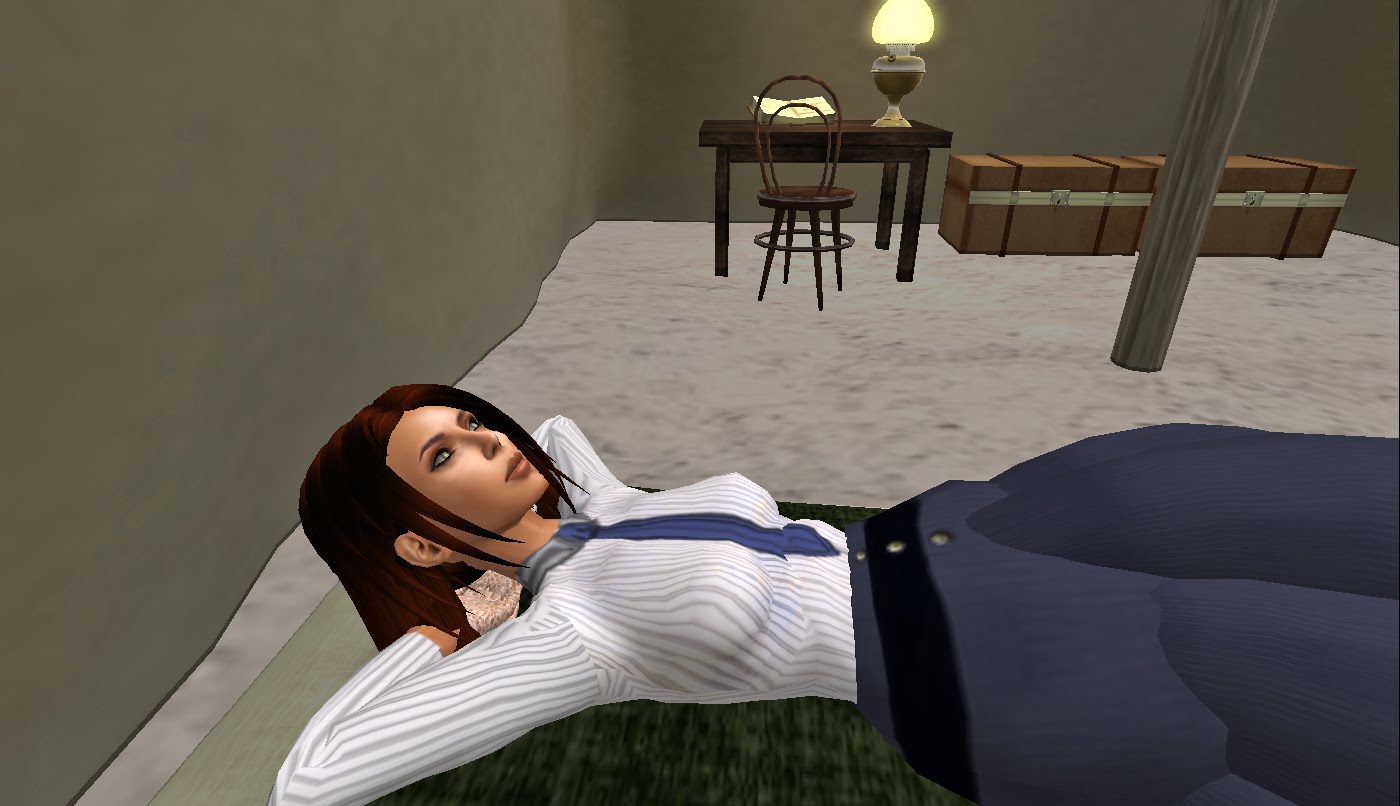
I rest in Mr. Carter's tent. (No, he wasn't there, you nosy people! I'm completely clothed, as you can see, the archeologists aren't my type, and, in any event, Heritage Key does not have those kinds of poseballs! Sometimes a nap is just a nap.) Another mini-game involves finding six lost pages from Howard Carter's Journal.


At long last, it was time to descend into the tomb! The stairs descend into the chamber below. Click on various objects to get information on them.


The next room is the burial chamber, with brightly-colored walls providing the story of King Tut's passage into the next world. There's a quiz about the depictions on the walls. No Gentleman's C on this test, though: all questions need to be answered correctly to win a prize!


Many of the valuable objects have been removed from the tomb itself, and are available for viewing in the nearby museum...which will be the subject of the next entry in this series.

Wednesday, May 5, 2010

My Journey to Heritage Key, Part 3 - Stonehenge

(Parts 1 and 2 here and here.)

Fresh from my adventure in Amarna, I returned to the Travel Center and walked through the "Stonehenge Portal." This transports one to a staging area, in which one has the choice of four different eras: 2400 BC, prior to the construction of the stone circles; 2300 BC, during construction; 1500 BC, in which one experiences life in a Druid village and a burial ceremony inside the circle; and modern day, in which one celebrates the solstice with modern Druids.

First things first, however: as with Life on the Nile, there are several Druid outfits from which to choose, in order to blend in with the natives. I change quickly, and approach my trusty guide.


First stop: 2400 BC! I walk up to the natives, who tell me a little about the place and their lives.

A mini-game involves wandering the perimeter of the setting, examining the informational signs that describe the flora and fauna one would have encountered at that time. Below, I pose with my prize!


Moving forward a century, I see the workmen erecting the great stones. Below, I help raise a stone into place. A mini-game involves helping a man repair his wagon by collecting nearby logs. Hey, no one ever said that exploring the past would be work-free!

The great slabs are largely in place, though the site does not yet look complete.


Following my guide to 1500 BC (you can see the blond man in the light-colored robe standing by the teleporter in the picture below), I start in the Druid village. The village has a funeral planned for the next day, and preparations are underway. I help prepare a simple meal by combining various ingredients. [Author's aisde: that taxed my cooking ability.]

I then participated in the funeral rites. The priest explains the scene. Signs provide information about how archaeologists made the finds that allowed them to draw conclusions about how Stonehenge was used.


Finally, I travel forward to the present day and see Stonehenge as it is currently preserved (including the highway traveling past the site). Modern Druids complain about the lack of access to the site and its proximity to the highway. Finally, I take a quiz to illustrate how little I really know about Stonehenge. (Look at the shadows on the picture below!)


At the end of another enjoyable day, I return one last time with my guide back to the portal, and from there back to the Travel Center, where another adventure awaited.

Wednesday, April 28, 2010

My Journey to Heritage Key, Part 2 - Life on the Nile

Walking through the teleporter to the Life on the Nile exhibit takes you to Amarna and the house of Setmare the Scribe. A variety of Egyptian outfits are available - I chose the "Beketaten" -, as well as a "journal" that keeps track of the mini-games in the area. (Sadly, the journal does not keep track of accomplishments between visits, so be sure to complete a set of accomplishments before logging out.)

The first room in the house is the western loggia, and appears to be used as a music room, with a lute and a flute-like instrument available. Below, I'm playing the solo in "Stairway to Heaven" - Jimmy Page, eat your heart out!


Setmare the Scribe is in the main hall. Come near him and he will say he does not recognize you, and challenges you to answer a question. Answer incorrectly and you may find yourself damp.

Other interior rooms include the entrance hall, the harem (!), and various bedrooms. Various household members interact to a limited degree with visitors, and a number of rooms have information displays with explanations about life in this time and place. Below, I play with makeup.


Don't forget to explore the roof of the house, the outbuildings, and the exterior. Below is an explanatory sign. Click on the prim to activates the sign. One of the interesting things is that the sign will display on the client side, so that avatars can read through the different screens at their own paces. (Note the small "1" in the upper-right-hand corner, signifying that we are on the first page, and the hand by the "click for more..." at the lower-right-hand part of the page.)


Without automation, a household this size took a fair number of servants to run. One of the mini-games involves finding these areas (not all have servants, such as the one depicted below) and sitting on the appropriate object to "help out" in running the household.

While you're at it, keep on the lookout for the four pieces of a letter that will help reveal a household plot. Solve the plot and reveal it to the correct person in the house and you could save the day! (If all that sounds too much like work, I assure you that the mini-games are not taxing.)

Before you leave for more modern times, be sure to find the river raft and play the game Rock, Scythe, Papyrus. (An ancient version of a game most of us are familiar with.) Win the round and your opponent moves backward, toward the Nile. The game ends when one player falls into the crocodile-infested river. (Fortunately, the sim is not damage-enabled.) Exploring solo? No problem. As one can see from the picture below, a hippopotamus is happy to assist. "Move, porky - you lost that round."


Next: to Stonehenge!

Monday, April 26, 2010

My Journey to Heritage Key, Part 1

At the risk of appearing to jump on the bandwagon – largely because I am jumping on the bandwagon – I thought I’d spend some time exploring the work that Rezzable has been doing with Open Sim. (For those who haven’t seen these excellent pieces, Dio Kuhr writes about her experiences here and Ariane Barnes writes here.)

Dio discusses Heritage Key as a learning envrionment, and has a brief interview with Rezzable's CEO, Jon Himoff. I'm no ed-yoo-cater; I'm more of a happy-go-lucky sort, interested in entertaining myself and others, and if I happen to learn something along the way, great. As a result, my perspective is a somewhat different one.

I'll start with a big thank you to Miss Viv Trafalgar, who made sure I was able to log in without trouble and spent a very pleasant hour or more with me (well, it was pleasant for me) showing me the welcome area, the travel center, and the various Stonehenge exhibits - more on those in Part 2 of this series - and pointing out the AO that, among other things, got rid of the horrid duck walk. Miss Viv, who has done extensive work for Rezzable both in Heritage Key and elsewhere, also discussed the ongoing evolution of the software behind the Heritage Key grid. [*N.B. All errors are those of the author, as the disclaimer in academic work goes. In addition, I haven't quoted Viv, in part because, in my scatter-brained way, it didn't occur to me until it was far too late that, gee, some our conversation might be of wider interest but by then it was too late to ask whether she would like to be quoted. Instead, you get my musings.]

Heritage Key is an OpenSimulator (or OpenSim) grid, existing separately from the Second Life grid, so it requires its own registration and avatar creation. OpenSimulator an open source server software designed to host virtual worlds. OpenSim looks a great deal like Second Life - I assume much of that was reverse-engineered from the SL server side - and uses the same communications protocols for client to server communication. As a result, any of the Second Life clients should work with OpenSim.

If my experience in Heritage Key is representative of OpenSim, the platform has come a long way from my earlier experiments with it. I would have login difficulties, suffer frequent crashes, and, during the infrequent times when I could both log in and not crash immediately, the lag was so intense as to render the platform unusable. This time, I've had no trouble logging in, have crashed only once, and performance has been fairly good. It seems to be rougher around the edges than SL, but the developers are no doubt heading rapidly in the right direction.

Heritage Key has its own client, which is a simplified version of a standard SL client. Start by registering at heritage-key.com (and that little hyphen is important; otherwise, you find yourself looking at the web page for a RL community in Kissimmee, Florida), create an avatar name - and, wonder of wonders, you're not limited to a menu of last names! - and default avatar, all of which come with some degree of a Steampunk outfit. Download and install the software (for Windows or Mac). The software launches with a click of a button on the HK site, as well as the usual way. Alternatively, one can configure a standard SL client with the "Target" line of properties to: -loginuri http://login.heritage-key.com . In theory, at least. When I tried this, I logged in but I stayed a cloud. For the moment, I'm sticking with the HK client.

After logging in for the first time, I found myself in the Welcome area.


This is a Roman-style plaza with a central fountain and statues representing various Heritage Key exhibits (e.g., an ibis and mummy) - and possibly future ones - note the terra cotta warrior. Below, the HK Rhianon:


At one end of the plaza is this globe, with teleporters that are set for destinations that appear to be children-oriented:


At the end is an AO vendor and four brass-and-glass teleporters. No clicking to "sit" in order to teleport - just walk in! The destinations: Skills Center, King Tut's Treasure, Travel Hub, and Avatar Center.

The Skills Center is a short tutorial on basic movement, communications, and inventory management. The Avatar Center has male and female avatars, complete outfits, several hair styles, and some individual pieces of clothing. There are changing rooms as well, for the modest. Below, I model the Steampunk top hat and goggles available in the area while standing next to "my" skin and shape. The family resemblance is unmistakable.


The Travel Hub, with its big brass clock as a centerpiece, has an information desk with signs that describe the various destinations. Around the edge of the room are teleporters for the various destinations: Life on the Nile 1350 BCE; Collections Gallery, Tut's Treasure; Valley of the Kings 1920s; Stonehenge Solstice; Stonehenge Portal; and, listed as "opening soon," The British Museum.


In Part 2, I discover intrigue in ancient Egypt!