Sunday, June 27, 2010

Gorey Ball for RFL


Mrs. Fogwoman Gray-Volare

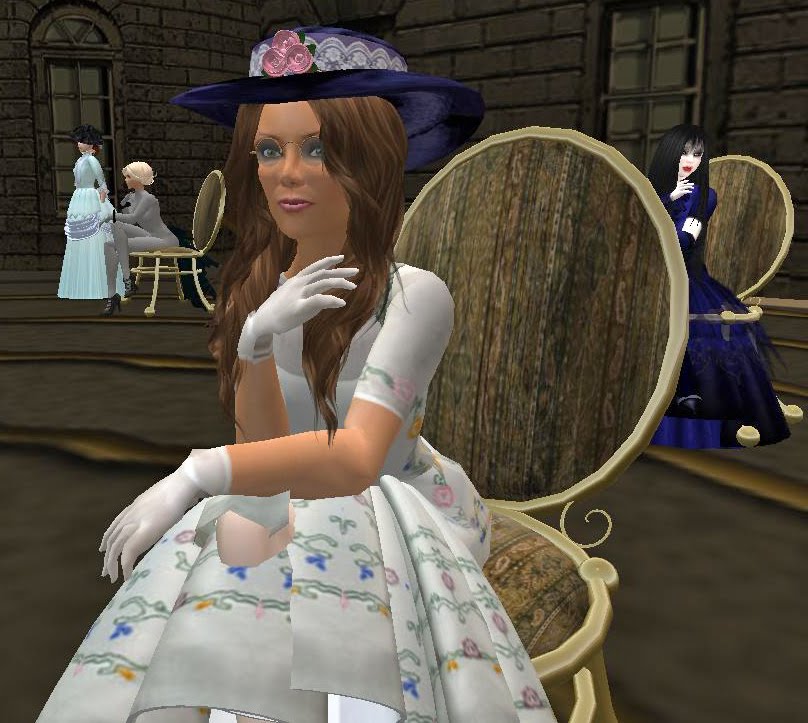
Sunday evening found me in a monochromatic state, attending Mrs. Fogwoman Gray-Volare's Edward Gorey-themed ball for RFL.

The setting, high above Tanglewood Forest, was created by Mr. Volare, and perfectly evoked Gorey's eerie drawings.

Miss Magdalena Kamenev provided the soundtrack for the evening, playing 1930s jazz standards, and many Linden dollars went to RFL.

For the entire set of daguerrotypes created that evening, see this Flickr stream.

Saturday, June 26, 2010

Seraph City Revisited

Having traveled to Seraph City earlier, while the 1920s Dieselpunk city was in its infancy, I thought I should revisit it and see how things were coming along.

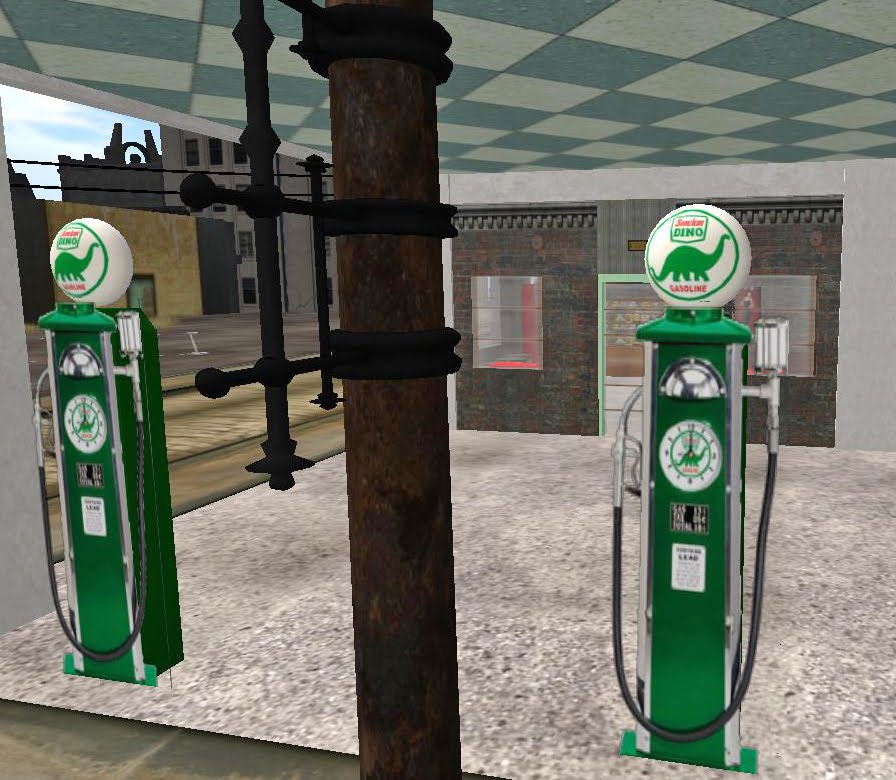
There's a gasoline station, with my favorite logo: Sinclair Oil, and the friendly-looking brontosaurus, no doubt representing the fact that the dinosaur is happy to have been converted to petroleum and then refined, for Your Driving Pleasure.


Buildings are springing up everywhere, and the streetcar system is rolling along.


The telephone lines are also in working order, should you know your party's number. (Sadly, no operators were on duty.)


The diner provides a spot for a quick meal.


This movie theater's exterior appears finished, but more work is required on the interior.


The town even boasts a number of those newfangled automobiles!


In my next post, a closer look at two of Seraph City's landmarks: The Carrington and The Empire Club.

Thursday, June 24, 2010

A Miscellany of Books

Not really a review of anything, more like a few notes on recent books. I've been musing lately over when to give up on a book. I usually try to slog through to the end, and I try particularly hard if I've purchased the book (yes, it's the Sunk Cost Fallacy, I realize that). Sometimes, though, it's a struggle, and as my pile of unread books grows I'm more inclined to stop struggling.
I generally enjoy Elizabeth George's Inspector Lynley novels, despite several maddening ones. (An aside: her 2006 outing, What Came Before He Shot Her, spends an entire book chronicling the young boy who killed a major character in the previous book. I should have give up on that one well before the end. It was a clumsy attempt at social commentary.) I was dismayed at the 700+ page behemoth that was This Body of Death, but I developed my arm strength - or kept it up, after Stephen King's 1000+ page Under the Dome - by reading it. Not bad for the last two hundred or so pages, but it took a lot of slogging to get there. Don't best-selling authors have editors? "Gee, Elizabeth, you've got a nice 300 page book here. Too bad it's more than twice that length."

Another book I nearly put down was Jeff VanderMeer's Finch. VanderMeer co-edited the anthology Steampunk, and an early review of Finch described the work as a Steampunk novel. Two problems: first, it's not remotely Steampunk. It's essentially a post-apocolyptic novel set in a city named Ambergris, which is under the rule of a fungal-based alien race. This leads to problem number two: it's not the first book VanderMeer has set in this universe, and Finch makes multiple references to earlier works and characters. Although it can be read as a stand-alone novel, I can't help but think I would have enjoyed it more having read the earlier books. It's another meaty tome, and for the first half or so it appears to be a detective novel - the title character is a police detective working for the alien "gray caps" and begins as Finch goes to the scene of a double homicide - before morphing into...well, it's not entirely clear what. Something else. Conspiracies abound, and, of course, the humans would like to overthrow their gray cap masters. Betrayals occur. Violence happens. I kept the pages turning, though, which I suppose is the point, or at least is half the author's battle.

I generally prefer novels to short stories because both require an investment in the characters and, especially in SF or fantasy, the world the author creates, and a novel allows both more latitude in developing characters and world and creates a lengthier payoff for the reader. But having lobster every night, no matter how good the lobster, starts wearing after a while. I find myself looking forward to the Neil Gaiman/Al Sarrantonio edited Stories, out June 15. The early reviews suggest that the quality of the tales is uneven. I don't find that surprising; even the stories of a single, talented author are of varying quality and, of course, subjectivity over different authors' styles comes into play in this kind of anthology. We'll see. Perhaps by the end of the summer I'll have made a noticeable dent in the pile of unread books. Now to find more places to store the read books...
Tuesday, June 22, 2010

Mason Labs Technology Escapes

I was reading through The Affinity Bridge, a vaguely Steampunky/Gaslamp Fantasy novel by George Mann, when I read the passage below and thought, “By Jove, these fellows have studied under Dr. Darien Mason! They even have a less-potent version of his Reanimation Serum!”

To set the stage, Sir Maurice Newbury, an agent of Queen Victoria, has been attacked by three revenants, victims of some sort of disease brought back from India that turns people into vicious creatures. Newbury survived the encounter and was brought to the house of the Fixer, who uses his amazing technology to keep the Queen alive as well as tend to serious injuries her agents suffer.


Newbury woke with a start.

He sucked at the air.

His head was throbbing, although he felt as if he’d somehow been infused with a warm, liquid glow; warmth that started in his belly and seemed to seep upwards towards his head, gloriously taking the edge off his pain and leaving his mind to wander in a drowsy state of semi-consciousness. He knew the sensation of old.

Opium.

Newbury peeled open his eyes, and then immediately shut them again. The light in the room was blinding, clinically sharp, and it seared the back of his retinas like a hot knife. He drew a ragged breath, pulling the air down into his lungs. His chest felt like it was on fire. Cautiously, he tried to open his eyes again, reaching up to shelter them from the glare with cupped hands. Stinging tears ran down his cheeks. He blinked them away. Finally, an image resolved.

He was lying on his back on a hard metal table. A face was looming over him. He tried to sit up.

“No, Sir Maurice. Try to lie still. Everything is going to be all right.”

Newbury felt a hand on his chest, holding him still on the table. He blinked up at the strange face that was hovering over him. The man was in his late forties, balding, with a neatly trimmed black beard. A bizarre mechanical contraption sat on his head, like a wire frame that encompassed his temples and forehead, with various accouterments and glass lenses attached to it on folding levers and arms. The man reached up and flipped one of these lenses down over one eye.

“Who are you? Where am I?” Newbury had a panicked edge to his voice.

“I’m the Fixer, and you’re in my workshop, underneath my home. You have nothing to worry about.”

Newbury breathed a sigh of relief, allowing himself to relax. He’d never had occasion to visit the Fixer before, but he was well aware that the man existed: a personal surgeon of Her Majesty’s who made himself available to her agents in times of dire need. He remembered Bainbridge speaking about him in the carriage, just after the attack. What was not good was the fact that, if he was here, his situation was potentially very grave indeed.

…He felt gloved hands tearing at his clothes and the faint stirring of a breeze on his exposed flesh. Nevertheless, the room itself was warm, and listening to the sounds around him, he had the sense of a workshop full of bizarre mechanical devices. There was a faint electrical hum, accompanied by the occasional sound of a belching valve as it issued forth a cloud of hot steam, as well as the constant tick-tock of numerous clockwork engines powering objects that he could not see from his limited vantage point on the table. Newbury tried not to imagine what the man was about to do to him with the strange machines that were making such sounds.

…The Fixer stood at the foot of the table, fiddling with an array of surgical tools, which pinged noisily on a steel tray. Beside him on a wooden trolley was a rack of steel hypodermic syringes, which contained a range of strange, multi-colored fluids. Newbury took the opportunity to take a better look at the man who called himself the Fixer.

Aside from the contraption on his head, the man was wearing a tarnished leather smock and matching leather gloves. Newbury couldn’t help thinking that he had more of the appearance of a butcher about him than of a physician. He had a ruddy complexion and the manner of a public schoolboy. Newbury suspected he spent a great deal of time in his workshop, and very little time engaging with the world.

…The basement was lit by a series of long, unusual gas lamps that arced across the ceiling from one wall to the other, curved glass tubes that terminated with gas valves where they met the walls at each end. An array of strange machines and surgical tables filled the space in between. One of these – a large brass contraption about the size of a small table, with two glass vats full of bubbling fluid atop it – had long coils of tubing that snaked out from the belly of the machine and away into the dark corners of the room. Another, smaller contraption was fitted with wheezing bellows of the sort Newbury had seen attached to Queen Victoria’s life-preserving engine. It even rose and fell with the same constant rhythm of Her Majesty’s breathing machine, although in this instance it appeared that the bellows were helping to power an unusual electrical device, the lights on it flickering from orange to blue as the exposed filaments danced with the current.

The alarming contraption above Newbury’s own table was connected to an extensive brass framework, a kind of large gun on a moveable rail, with fat tubing trailing from the back of it and disappearing into a nearby hatch in the floor. The device had a trigger fitted to the undercarriage and the end of it terminated in a spread of fine needles, bunched together to form a neat point. Newbury shivered.

The Fixer turned to notice him looking. “Impressive, isn’t it?” He turned to encapsulate the room with a gesture of his arms, indicating the various machines. “This is what Dr. Fabian gets up to when he isn’t busy attending to Her Majesty or running errands for the likes of you and Sir Charles. Works of genius, every one of them.”

Groggily, Newbury met his gaze, and felt immediately disoriented by the sight of the man’s strange eyewear, which magnified the appearance of his right eye so that it seemed at least three times the size of his left. “So, what’s next? Surgery?”

The Fixed smiled. “Of a sort. I’m going to knit your shoulder and chest back together with my stitching machine.” He indicated the gunlike device on the rail overhead. “Then I can give you a blood transfusion and a dose of one of Dr. Fabian’s excellent compounds.”

Newbury narrowed his eyes. “What will it do?”

“Fix you, of course.” The man beamed….”When the powder is dissolved in saline and transfused into the human body, it boosts the existing immune system, helping the blood cells to clot and bind, so that muscles and bones can reconnect very swiftly indeed….”

(From George Mann, The Affinity Bridge, pp. 220-25.)

Monday, June 21, 2010

Aether Salon: Photography!

June's Aether Salon brought Mr. PJ Trenton to New Babbage to discuss his passion, photography. Mr. Trenton is a freelance photographer, as well as a photographer for a number of magazines, including the Primgraph, and is well known throughout the Steamlands for his artistic prints.


After a brief introduction to the Salon by Miss Jed Dagger and an introduction of the speaker by Mr. Jasper Kiergarten, Mr. Trenton began his talk, aided by the projection of images onto a frame.


He noted that the precursor to the camera and photographic development process was the camera obscura, a box with a pinhole that projects an image on a screen. In the 18th century, Johann Heinrich Schulze discovered that various silver salts darken in the presence of light. Thomas Wedgewood attempted to use this discovery to record an image on a surface, only to find that the image continued to darken over time, and thus was not permanent.

French inventor Nicephore Niepce was credited with the first "permanent" photograph. Niepce had the insight that what was needed was a substance that would become light, not dark, when exposed to light, thus creating a negative of the desired image. Shortly afterward, fellow Frenchman Louis Daguerre developed a process using copper plate coated in iodine, then exposed to light, subjected to mercury vapor, and "fixed" by soaking the plate in salt water. In England, William Fox Talbot made a nearly simultaneous discovery.

As the photographic process continued to develop through the 19th century, photography portrait studios became popular, despite the lengthy times (on the order of 30 seconds) subjects were required to remain perfectly still. Other photographers focused on more artistic pictures, including allegories and depictions from literature.


I found the talk to be fascinating and, judging from the questions asked afterward, I was far from the only one.


One of the guests at the Salon was none other than Mr. AM Radio:


As usual, a good-sized crowd came to hear the speaker and was most enthusiastic in their appreciation of the talk.


Sadly, this was the last Salon for the season. Happily, a new season begins in Autumn, a few short months away.

Sunday, June 20, 2010

Nemo II

When last we saw Nemo, the Jules Verne-inspired underwater Steampunk city existed solely beneath the waves. Now a second round of development has left in place an entire surface city that surrounds the submerged part, including a High Street with various shops.


The transit system is quite simple. Each railcar moves between two stations only in a quick, efficient trip.


This enormous Steampunk ship appears to be in drydock.


The interior is roomy and outfitted with the latest in navigational devices.


A look at the engine room.


Another short tram ride away are the mines. Enormous drilling and conveying devices extract the mineral wealth of Nemo.


Back to High Street, where those familiar with BlakOpal Designs will find a familiar storefront:


At the head of the street stands the observatory. In the bottom level is an orrery...


...while above stands a precision-made telescope.


Mr. Sextan Shepherd has made a fine addition to Nero's realm. The attention to detail in the build is amazing.

Friday, June 18, 2010

My Ode to the Aetherwebs

One of the great things about the Aetherwebs is that it illustrates quite vividly that We Are Not Alone. Oh, I don't mean the extraterretials with whom we may or may not share a planet. I mean that, in a planet of six billion people, more or less, whatever your particular set of circumstances, someone out there shares those same circumstances.

Depressed? Plenty of fellow sufferers. Repetitive strain injuries? Ditto. Fetish for naked midgets? Yeah, probably that, too. In the pre-Aetherwebic Dark Ages, you might live in a small town where (a) it might be the case that no one else has what you have, and thus no one knows what you're going through, or (b) someone else does, but neither of you wants to admit it to the other. Alternatively, you might live in a large enough area to know that someone out there shares your problems, but you also have no way of contacting him or her for a little empathy.

So thanks to everyone who has shared something potentially embarrassing about herself, even if pseudonymously. Someone feels better because of it.

Wednesday, June 16, 2010

Clos Normand: Seeing the French Countryside

When I heard that Miss Soliel Snook and Miss Elize Foxclaw were advertising rooms to let in Clos Normand, I had to take a look. They said the area, next to Giverny, reminded one of the French Countryside, circa 1900-35, and they were not exaggerating. Look - horses!

And cows!


Miss Foxclaw's Bluebells Art Studio is also here...

...featuring original art.


Some residences are already occupied, including Miss Nox Pinion and her Tea & Strychnine shop.


Water powers Tea & Strychnine:


Another presence is that of Baron Klaus Wulfenbach and the Consulate of Europa Wulfenbach.


With Miss Pinion and the Consulate, along with the physical location of Clos Normand, if I didn't know better, I would have thought it the second coming of the late Murdann!

Monday, June 14, 2010

A Question of Ethics

In wandering through the Downs, I noticed this small store front. It reads "Haven Rental Office."


On the side of the building is a sign advertising Haven Township. The sign reads: "Explore this unique community! Shop & Land rentals... Steampunk vehicles, Gadgets & more"


On the one hand, promoting Steampunk-themed areas is good business for everyone involved. Indeed, the late Steampunk Resource Centre, just up the road in Caledon Downs, did just that.

On the other hand, promoting rentals in another sim...it's using the Guvnah's own properties to advertise for the competition. Somehow that doesn't seem quite right. I have nothing against Lady Kenyon - I have met her once, during a hunt, and she is a lovely and talented person. And perhaps the Guv is fine with the whole concept. It just seems odd.

Should anyone be curious, Haven Township does have some Steampunk elements, as the Aetheric Power Co. depicted below shows:


I tend to think of it as somewhat later than the traditional Steampunk era (should such a thing exist), which I tend to think of as encompassing the mid-to-late Victorian age, with some Edwardian era thrown in for good measure. The cars and buildings in Haven Township seem a little later than that, though I'll admit to being no expert on the subject.


Sunday, June 13, 2010

Breakfast in Babbage - Western Edition

Another Breakfast in Babbage at the Clarendon, with His Grace, Edward Pearse. Or, as Lord Primbroke was known on Saturday, Tex, as the theme this month was the Western.


Songs about the West, songs from Western movies, even songs by actors in Western movies. Below, Mssrs. Elilka Sieyes and Elina Koskinen as the Watson and Holmes cacti.


I learned that Clint Eastwood can sing...and that Lee Marvin cannot. That was ghastly! Below, the crowd dances.


Ghastly, yes, but not as ghastly as The Legendary Stardust Cowboy. We begged Tex, er, Mr. Pearse to make the noise stop. He relented, only to put on Bon Jovi. It was a considerable improvement. Below, Miss Searra Weatherwax, Miss Bookworm Heinrichs, Miss Sky Netizen, Mr. Charlie Quintessa.


Miss Cyan Rayna was not in a dancing mood.


Our hostess, Miss Dierdre Maven, and Miss Breezy Carver.


Miss Elleon Bergamasco dances with Mr. Quintessa.


I attempt the two-step. The picture above is priceless.


I had to leave the roundup before I found out whether Weird Al made any cowboy songs. If so, I have no doubt they would have found their way into the playlist.