Friday, April 20, 2012

SL Turns 9 and I'm Celebrating at Home

Linden Lab has decided against the traditional Second Life birthday celebration: a series of invited builds, designed around a theme, and placed on a series of temporary sims. The Lab's blog put it this way:

Second Life’s 9th Birthday is coming up in June! This year it’s all about you — the denizens of the grid, the sultans of Second Life and connoisseurs of creativity— and we want to highlight the many unique and innovative ways the community has made Second Life their own.

This year we will focus the spotlight on community events. No one throws a better event or party than the Second Life community! If you’re having an event to celebrate Second Life turning nine, we want to know about it!

Miss Inara Pey calls this the "end of an era" and says

In previous years, Second life’s birthday has been marked through a coming-together of the community as a whole on a set of regions supplied by Linden Lab, to create a glorious theme park of builds and ideas created around a central theme, and in and around which parties and celebrations can be held. While not always free from controversy and acrimony, this approach provided a focal point for events and activities marking SL’s birthday, and helped to bring together residents from across the grid.

Well, not any more.

Hidden within this announcement is the fact that this year there will be no large-scale provisioning of regions by LL; no central place to explore (lag and all) and see builds great and small and enjoy the thrill of celebration and discovery.

And this is a shame.

The SL8B events have traditionally been a marvellous way for the many talents and groups across SL to showcase their work, their talent and their vision. It’s hard to see how such an infinite diversity of ideas and vision can be replicated through a process of complete de-centralisation; one cannot imagine sim / estate owners / groups developing large-scale builds specifically for SL9B, especially with so broad a theme as has been offered.

I confess more mixed feelings about the announcement. On the one hand, the birthday celebrations I've been to had a sense of community about them. I've reported on bits and pieces of SL5B, SL6B, SL7B, and SL8B (spread across three entries), and found things to like about each of them. On the other hand, the lag has always been so intense that moving through the soup-like atmosphere has been a painful experience. While having all the exhibits in close proximity to one another has its advantages, teleporting to different exhibits might be more enjoyable…if people care to build them, that is.

And that's really what the concern is, it seems to me. Without Linden Lab inviting individuals and groups to submit entries, without the Lab to provide the land and organize the event, will there be an event? Why should Caledonians and Babbagers and Furries and, uh, Goreans take time from what they're doing to celebrate our platform if our overlords don't seem interested?

Crap Mariner has what seems to be a reasonable take on things (plus links to other people's thoughts, conveniently lying there for the interested but lazy reader.

Will it work? Will it fail?

I guess we'll see. I kinda like the idea of communities being able to build their own concepts, hold their own events, police their own grounds, work together on their own terms, manage their own resources, and not have to depend on well-meaning (but overwhelmed) folks like KT and Doc and Harper for fear of offending someone.

Sure, it was convenient to have it all in one place, and the hodgepodge of builds gave people exposure to different communities and experiences and expressions and arts with a simple stroll around.

But then, looking back at my spreadsheets of the maps of the past few SL#Bs, they also were devolving into shameless marketing and advertising plots, and if you looked at many of those builds, you'd have no idea what the theme was. At least some folks like RacerX combined art and whimsy in the form of an invitation and not a blatant advertisement, or pallina60 doing out and out magic and beauty.

...

So, it's not all going to be in one place? Fine... with region crossings the way they are, adjacent sims under heavy load are about as crossable as a teleport. And any decent event at SL#B was a sea of grey avatars and people bitching about lag and rezzing, anyway, right?

But when it comes to the barrier to entry, yeah, it sucks for the individuals and rogues and small-potatoes microcommunities, because they might not have enough resources to put something together like larger groups would, but as long as SL's pricing structure remains ludicrously expensive, them's the breaks, baby. Perhaps LEA or some other group will step up and bring those folks together... art galleries and all...

We'll see, won't we? And in any event, "your world, your community," or whatever the tag line was, should mean something, no?

Wednesday, April 18, 2012

The Humble Commas

I don't have much use for the New York Times, but occasionally the writers remind one of why the paper used to be great. This piece by University of Delaware professor Ben Yagoda on the changing use of commas, is one such reminder. For example:

As a professor at the University of Delaware, I read a lot of writing by college students, and in it a strong recent trend is reversion to comma-by-sound. I attribute this not so much to students’ love of the Constitution and the classics but to the fact that they don’t read much edited prose (as opposed to Facebook status updates, tweets and the like). Two things that you really need to read a lot to understand are punctuation and spelling. (Not coincidentally, spelling is the other contemporary writing disaster.)

As far as comma use goes, my students play it by ear. I see this most dramatically in sentences that start with conjunctions like “And,” “But” and “So.” (Your junior high school English teacher may have told you never to start a sentence with a conjunction. To the extent that was once true, it isn’t anymore.) So students will write sentences like this:

So, students will write sentences like this.

But, they are wrong.

You see this kind of thing all over the Internet as well. People punctuate that way because, if they spoke these sentences, they’d pause after the conjunction (and because the extremely fanciful and undependable Microsoft Word grammar and style checker refrains from applying a squiggly green underline).

One of my work tasks is to edit memoranda (often lengthy documents) of case fact and analysis that will ultimately be read by Commissioners and their advisors. Most people can write fairly coherently, so I spend time fine-tuning grammar, punctuation, and the like. It turns out that even well-educated people have all sorts of trouble with commas (and, worse, semicolons), to the point where I sometimes suspect people of randomly inserting commas.

It's good to know that there are others out there continuing to fight the good fight.

Monday, April 16, 2012

Warren Town - Steampunk Roleplay in the 1860s

Warren Town 001

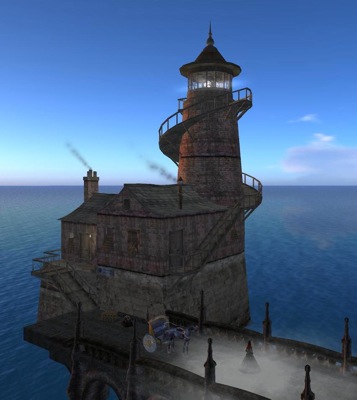
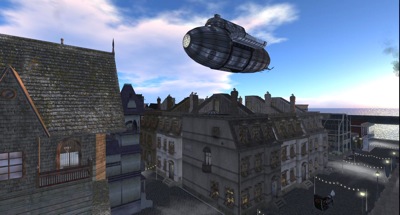
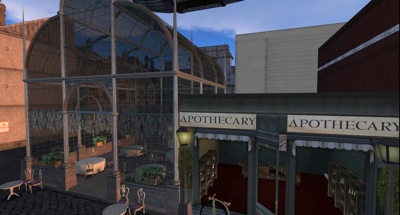
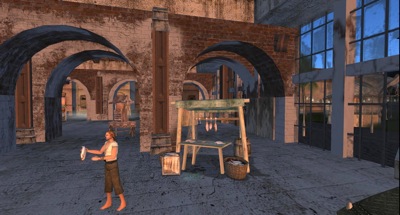
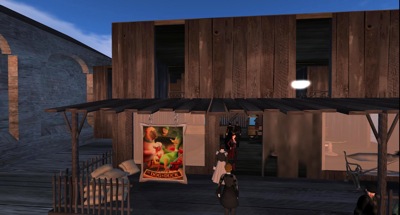
I made my way to Warren Town, a new RP sim, set in the 1860s.

Warren Town 002

Some background:

It was 1863, on the west coast of England. A small town founded by the Warren family, earns a spot on the map just at the very end of the industrial revolution by their advances in chemistry, astronomy and last but not least, the rubber industry. There was something about the town that has attracted great intellect.

Yet, as the industrial acceleration slowed down, Warren started receiving new visitors from the neighboring towns who came in search of some of the famed prosperity. To the locals dismay, these were not the most lectured of scientists or renowned minds, but gypsies (at times called 'carnies', since they traveled with a carnival circus) and a considerable troupe of burlesque entertainers. While in previous times the locals would have simply hanged them or blatantly expelled them...they were injecting good money into the town and attracting all sorts of tourists.

Things were just starting to heat up.

Warren Town 003

Various roles are advertised as still available to fill:

Warren family members - The eldest family member and head of the house is Baronet Henry Warren who has two siblings: Julian and Anna. A widower, now is juggling to keep the balance between the old order and more traditional part of Warren, with the newcomers (gypsies and burlesquers). Stubborn, strong and resolute are the most marked characteristics of its members.

Rothschild-Pinkerton family members - At the moment we two siblings of these prestigious American families, and one cousin. The Rothschilds of the United States were perhaps one of the most wealthiest families, in 1850 having a net worth of over six billion dollars, theirs was a collective to which few could rival or thwart. Frederick and Georgiana Marie, born of famed tycoon Gregory Rothschild and Wilimena Pinkerton, was in her own way an aristocratic noble.

Gates American family members - The Gates family is one of the older, more distinguished families in New York. In 1863, a small portion of the family decided to try and spread the family fortune to Europe, believing that this was the best way to expand both the family name and the family business. At present, Paul John Gates is the patriarch of the family. In his absence, his eldest son Jackson Anthony Gates, is in charge of day to day family matters and business (The Empiric Electric Co).

Astrology Center Director - A position suited for the fanatics of Steampunk and where to explore this sub-theme fully. The position comes with an observatory near the harbor, and all sort of experiments and odd ventures are encouraged.

Hotel owner - The hotel is one of the most fascinating of our buildings, and it is said that is it haunted. We are looking for a spooky character to run it, and welcome visitors. Someone who will somehow work on the shadows too, knowing everything about who stays there, and using it to his/her advantage. Opportunity exists for espionage and why not, murder. [Why not indeed! - KJ]

School Headmaster/mistress & Priest - A different type of roleplay, not for anyone. These two roles should be filled by people who would enjoy being the ultimate ‘grinch’ as they would be the most affected by the upcoming circus and specially the burlesque theatre –(erected just in front of their buildings). As the congregation and pupils leave the premises, they would run into scantily clad can-can dancers, and smoking, devious men. Ironically, we have named the chapel “St. Mary’s”, as in Queen Mary Queen of Scots, but these institutions respond to the Church of England. Oh English sarcasm, you do us good.

Merchants - We are looking too, to fill the roles of: baker, dressmaker, florist and hashery owner. These merchant roles have a specific small house assigned with the shop on the ground floor. There are also two of these houses empty for any store you may want to come up with. Contact Hilda Bellingshausen if you wish to fill any of there roles.

Warren Town 004

As I wandered the town, there was a "50th anniversary" celebration in progress…with many of the townspeople gathered by the pub.

Warren Town 005

Warren Town 006

Warren Town 009

Warren Town 008

The sanitarium is a fearful place, whether in its heyday or in its current ruined state.

Warren Town 007

Warren Town 010

Warren Town 011

Warren Town is advertised as a fully-immersive RP sim (i.e., all remarks are to be in-character), using paragraph-style play, which is not everyone's cuppa. One nice touch is that there is no HUD, no "Observer" name tag - observers should just be discreet and not interfere with ongoing RP.

We'll have to see what story lines emerge!

Saturday, April 14, 2012

What Else Ya Got?

As no doubt everyone knows by now, the Antitrust Division of the Department of Justice filed a lawsuit against Apple and five book publishers (three of whom simultaneously settled by entering into a consent agreement with the Division), alleging that the firms colluded to raise retail prices of ebooks.*

The complaint has a number of specific allegations, including a "most-favored nations" requirement (publishers can't sell ebooks elsewhere for less than they sell via Apple's iBooks store), but the basic story is that the publishers were unhappy that Amazon built a large - around 90% - share of the ebook market by aggressively pricing ebooks, often below wholesale cost, thereby threatening the pricing structure of physical copies of the books. Apple offered a different pricing model, in which publishers would set the retail price of ebooks and Apple would take a 30% cut of that price. This allowed the publishers to increase the retail price of books sold through iBooks and reduced the publishers' dependence on Amazon. However, the complaint continues, no publisher was willing to do this alone; meetings among the publishers and assurances by Apple that all the publishers would be on board were required to convince all five to agree to Apple's proposed agency model.

The complaint details meetings among the publishers - at tony New York City restaurants, no less, prompting some readers to suggest that the government is trying to out-compete Zagat's - where, it is alleged, the publishers conspired to find ways that, collectively, they could gain the upper hand over Amazon and get rid of the $9.99 price point for ebooks. One possibility discussed was the agency model. Consequently, the government's case against the publishers is fairly well-specified in the complaint. In contrast, the evidence against Apple seems quite weak.

Apple's role seems to be two-fold: first, Apple insisted on the agency model - the same agency model it uses for its iOS and Mac app stores, so this wasn't something Apple cooked up for the book publishers - and, second, Apple, in negotiating with each publisher, made assurances that the other publishers would be on board for similar terms.

Apple's insistence on the agency model shouldn't be either surprising or problematic. Apple chose a different approach to retailing products than did Amazon, and applying the same model to books as it uses elsewhere was a logical step. One could criticize's Apple's 30% commission as being too high, but it's hard to argue that Apple has market power in the ebook market, when estimates are that Amazon sells about 60% and Barnes & Noble another 25-30% of ebooks. Furthermore, because Amazon sells stand-alone Kindle readers, and doubtless has sold substantially more Kindle readers than Apple has sold iPads, Apple can never exclude Amazon from the ebook market (rendering irrelevant comparisons to Microsoft's actions with respect to Internet Explorer - another dubious antitrust case, to be sure).

More troubling is Apple's role as mediator among the publishers. But this, too, should not be problematic. Apple was trying to start a new virtual bookstore, and could not launch an effective product without having available a substantial proportion of best-selling books. Apple had a legitimate business interest in ensuring that the iBook store opened with books available from multiple publishers. Similarly, no publisher would have a serious interest in Apple's agency model - annoying Amazon, the largest purchaser of both ebooks and conventional books - without assurances that other publishers were along for the ride. Thus, Apple's assurances that other publishers were in similar negotiations with Apple, and on similar terms, was almost surely necessary for a successful launch of iBooks.

The idea that Apple benefits from higher ebook prices needs to be carefully examined. Because Apple receives 30% of the price of an ebook, higher prices do benefit Apple. At the same time, however, Apple earns substantially higher margins by selling hardware, so it's not at all clear that Apple's incentives are aligned with those of book publishers. (For one thing, Apple receives no revenue from hardback or paperback sales, so Apple (1) has no interest in maintaining higher prices of physical copies and (2) has every incentive to increase sales of ebooks.)

Antitrust enforcers rightly take a dim view of restrictions enacted by firms with market power, as those firms have an incentive to maintain their market power by excluding competitors, and often have the ability to do so profitably. In this case, however, Apple created a new competitor, the effect of which was to reduce the market power of the entrenched ebook seller, Amazon. Nothing in Apple's agreements with publishers prevented publishers from discounting titles, as long as discounts to other sellers were also reflected in the price in the iBooks store. (As I read the complaint, the various pricing tiers were price caps, not floors, for various book categories.)

It's a little disturbing that the Antitrust Division would include Apple in its list of defendants. The signal it sends to firms is that it's dangerous to buck the status quo. A cynic might think that the Division was more interested in generating headlines, and that an antitrust case against Apple was more headline-grabbing than a case against just the publishers.

---------------------

*Opinions here are my own, not my employer's, etc.

Thursday, April 12, 2012

Twenty Minutes Until Midnight

Henry Connolly opened his pocket watch for perhaps the fifteenth time that evening. Twenty minutes to midnight. Twenty minutes until he was free. He adjusted himself in the plush leather chair in the study and sipped his whisky before replacing the crystal glass on the side table.

He was enjoying his luxurious lifestyle courtesy of his wife, Evangeline. Henry himself had but a modest income. He was an entrepreneur, but thus far he had found no one to back his proposed businesses. Even his wife was skeptical that any of his ideas would earn a return on investment. Truth be told, Henry acknowledged that he was more of an idea man than a nuts-and-bolts man - the thought of actually running a business bored him to tears. Much better to think through new ideas and leave the details to those who were good at that sort of thing.

His one success was in convincing Evangeline to marry him. Her father was wealthy and doted on her, so winning Evangeline's heart was tantamount to winning her father's approval, along with a generous income. This suited Henry very well, at least for a time, until Evangeline showed more of a practical side than he had given her credit for. Not only did she refuse to invest in his business plans, but she had the audacity to suggest that he was not applying himself to earning a decent living.

She did agree to one suggestion of his, which was to finance a trip to the Greek isles. First-class berths, of course. Unfortunately for Evangeline, she mysteriously fell overboard during the voyage out. The distraught widower naturally cooperated fully with the Greek authorities, who ultimately determined that Evangeline suffered a tragic accident. He returned to his estate wearing a suitably sorrowful expression.

He had one stroke of luck about a month later when Evangeline's father, grief-stricken over the loss of his daughter, suffered a heart attack and died. Now Henry had but to wait the remaining six-and-one-half years to have his missing wife declared dead and he would inherit her now much larger estate. He would be free to become the success he knew was his destiny. That moment would arrive in - he checked his watch again - precisely six minutes.

The doorbell rang. Henry frowned. A caller at this hour? He let his butler rouse himself from bed and answer the door. Henry checked the watch one more time out of reflex.

The sound of several pair of feet on the wooden hallway floor came closer, and the door to the study swung open. There stood Evangeline as though no time had passed since their last meeting. Two policemen flanked her.

"Hello, darling. I hope you enjoyed the past seven years.... No, not quite seven, is it? When I was rescued after you so thoughtlessly threw me overboard, I considered going to the police immediately. Before I could arrange for passage back home I saw that my poor father died, and I understood what your plan was. Then I thought that it might be infinitely more cruel to wait until the stroke of midnight on the seventh anniversary of my disappearance to return home. Here I am... now stop drinking my whisky and please vacate my house immediately."

As the clock chimed midnight, Henry gulped the last of the amber liquid as the policemen advance toward him.

Tuesday, April 10, 2012

Surrounded by Divas

Just a little observation from the typist's place of business: I've noticed that email is the preferred method of communications when the initiator wants a record of the conversation, and the telephone becomes the preferred method when a record would be inconvenient. (I'm occasionally guilty of this myself.)

I emailed a colleague - at the request of my boss - to see if I could negotiate a date for him to complete and submit a report. My purpose in using email was not the passive-aggressive one described above. I was just trying to avoid an unpleasant conversation.

Sadly, my hopes were dashed when I received a phone call in reply. The call started with, "I'm not going to bargain on timing." The diva went on to say how long it was going to take to do this job (leading one to think that, far from being nearly done, as was supposed to be the case, he had barely started the project), and how he was only going to let other people see the product when it was completely polished; otherwise, he claimed, readers would "talk s**t about his work" - unfairly, he implied. When the conversation circled back to timing, he told me to take it whenever it was done, no commitments on his part, or he wasn't going to bother to finish it at all. I ended the communication quickly, lest I say something I would later regret.

I'll have to say I wasn't really surprised to hear that his next order of business was to leave two lengthy phonemail messages with my boss, complaining about me, how I impugned his reputation and treated him poorly, blah blah blah.

Divas gotta sing, I guess.

Sunday, April 8, 2012

Civil War Discussion - Whitman's Journals

March 28 saw the continuation of the Civil War discussion group, with Sir JJ Drinkwater...

Civil War Discussion 3 28 12 002

…and Dame Kghia Gherardi (and me, of course).

Civil War Discussion 3 28 12 003

The event was listed in the SL directory of events, on the splash screen of the official SL viewer, which brought a number of first-time attendees, including (shown below) Miss Luna (with the claws), Miss Kate Hershey, and Miss Roxie Marten.

Civil War Discussion 3 28 12 001

Others in attendance were Mr. Bruce Mowbray, Miss Marcella Kozlov, Mr. Crassvs, and Mr. Goblin Crosby.

Civil War Discussion 3 28 12 004

The text for the evening's discussion was three brief essays from Whitman's Specimen Days, which is described as follows:

Specimen Days first appeared in 1882 within a volume entitled Specimen Days & Collect, published by Rees Welsh and Company in Philadelphia. Composed in 1881 largely out of notes, sketches, and essays written at various stages of the poet's life from the Civil War on, it is the closest thing to a conventional autobiography Whitman ever published.

The largest and arguably the most important work of Whitman's old age (except for the reordering of Leaves of Grass during the same period), the book deserves attention as more than a source of information or for its moving descriptions of the poet's experiences in the Civil War, which have in the past been the chief sources of its interest to scholars. The book attempts to link Whitman's life history to national and natural history while presenting itself as the casual reminiscence of a man approaching death. It therefore resembles what students of aging term "life review."

The three essays, "Union Prisoners South," "Deserters," and "A Glimpse of War's Hell-Scenes," reflect some of the brutality and inhumanity of the war, and perhaps a diminution of Whitman's celebration of the potential of America that came through Leaves of Grass.

Friday, April 6, 2012

A Ghost Story (Part 2)

(continues from part 1)

Time passed. The food and brandy were long gone. Mr. Dickens was not doing an especially good job at keeping me awake. It is certainly possible I nodded off at some point, only to wake with a start at a noise from upstairs. My heart pounded and I listened carefully, wondering if I had indeed heard something or whether it was just part of a waking dream. Thump. There it was again. Thump. And again. This sounded like no spirit I had ever heard of, though admittedly my first-hand knowledge of such was slight. I picked up the lantern and my pistol and cautiously made my way up the stairs, listening for the sound as it repeated in order to locate its source.

I opened the first two bedroom doors but, as before, found nothing unusual. The sound was definitely louder on this floor, however, and that left only the locked room to explore. I sighed and walked back downstairs to retrieve my set of lock picks, walked back to the third floor, and set at the door.

The locks were not particularly complex, as it turned out, and even my modest lock-picking skills were enough to have the door open in under ten minutes. It might have been quicker, had the insistent thumping not unnerved me, wondering what I might find on the other side. I drew my gun, turned the knob, and pushed the door open.

As soon as I entered the room, I put the gun away. I could see the source of the thumping: a potted plant holder, suspended from the ceiling, was swaying to and fro, banging on the wall with each movement. The source of the movement was also clear: a translucent form of a young woman was in motion, creating just enough air movement to keep the plant holder swaying. She was dressed in an evening gown that might have been fashionable a decade or two ago. Her face was hard to make out in the dim light of my lantern, but, from what I could tell, her slender features were horribly distorted in a rictus of pain.

When the ghost saw me, she became still and the plant holder slowly swayed to a stop. “Thank goodness you heard me,” she said in a whisper. “I had nearly given up hope that anyone else would come into the house, much less be able to hear me and open my bedroom door.” My only response was to gape at her.

“Come closer, Miss. I can no longer speak loudly, though it is a wonder I can speak at all. My name was Constance Jefferson, and I have a favor to ask of you.”

“M-miss Rh-rhianon Jameson,” I managed to stammer out, “and I am at your service, Miss Jefferson.”

After my shock had worn off, Constance Jefferson turned out to be a charming young woman - young-appearing woman, at any rate - with a sad story to tell. “My father was a wealthy man, having made his fortune himself in the shipping industry. He had this house built and furnished, sparing no expense, not because he liked the trappings of the wealthy but because he craved the social status that his wealthy neighbors enjoyed. He knew that he would never be quite accepted in their society, but he schemed for some years to have me engaged to an aristocrat whose family would allow me - and, by extension, my father - entry into the highest echelons of society. I realize that sounds a bit harsh, and I do not mean it to be. My father loved me above all else, and he truly believed that such a life was something I would want for myself.” As Constance talked, her voice became stronger and she appeared to be more solid than she had earlier.

“When I was sixteen, I became engaged to the son of Lord Carrington… not engaged, perhaps, but more of an understanding between our two families. At that time, we had never met, not that such a meeting was deemed to be important. I accepted this as an obedient daughter. The following year, however, I met Tom - Thomas Smythe. Tom was apprenticed to our landscaper, and we talked on numerous occasions as he worked on various parts of the property. Brief conversations, to be sure, but we fell in love. I knew Father would have considered him entirely inappropriate for a husband, but I didn’t care about that myself. We kept our relationship to ourselves as long as possible. One day Tom seemed unusually tongue-tied, and I soon discovered why: he intended to propose marriage. He had purchased a small engagement ring and fell to a knee as he asked me to marry him. I think I giggled a bit before saying yes. That was as happy a moment as I had ever known.

“Yet even then I knew the time would have to come when I would have to tell Father the news. He would not react well, I knew. I considered various ways of approaching him, rejected them all, and considered them again. Tom had offered to be with me, to seek Father’s blessing, but I said no, this was something I needed to do on my own. When I finally summoned the courage to tell Father, the conversation went even more poorly than my darkest fears allowed. Suffice to say that Father confined me to my bedroom and installed the locks that you now see on the door. I was a prisoner in this house and, of course, Tom was forever barred from it. I never saw him again.

“Father must have assumed that I would come to my senses, forget Tom, and again agree to marry the Viscount. I never did. Indeed, from that day on my appetite was gone. I became thin, then gaunt. My parents tried to induce me to eat and summoned several physicians, each of whom departed no wiser or happier. Eventually I became too weak to stand and spent the next week in bed, being fed broth and other liquids whenever Mother could force some into me.” Constance looked at me. “I suppose you think me a foolish, lovesick girl, Miss Jameson.”

“I was young and foolish myself once upon a time,” I replied. “I will admit I have never felt the power of love the way you did, Miss Jefferson.”

The ghost sighed. “One of the advantages of the time that has passed is that it has given me the opportunity to think about how I really felt and the choices I made. Indeed, I have had little opportunity to do anything but think. Yet I am also eternally seventeen, so while I have had the perspective of time I have not had the perspective of age.

“On my last day,” she continued, “I rose from my bed and stumbled to the dresser you see here. I had secreted Tom’s engagement ring in a hidden compartment in the dresser - Father would have destroyed the ring had he found it - and wanted to see it again. I fumbled with the latches but, in my weakened condition, I could not open the compartment. My heart gave out at that moment and I died.”

“And yet here you are still,” I commented.

“Yes. I found that I was freed from my body, and yet unable to leave my room even then. I could not touch anything, for I have no corporeal form. Surely, I thought, this cannot be the fate of everyone who dies, or the world would be inundated with ghosts. Yet the years passed and I seemed no closer to discovering the mysteries of what lies beyond than I did on that first day.

“I tried communicating with the living, but I had no voice - or no audible voice, at any rate. I was also quite indistinct, so people who came to the room would sense my presence more than see me. This was enormously frustrating to me.

“My parents moved out of the house, locking the door to my room before they left, and attempted to sell the house. I think one or both of them sensed I was there, even if they could not see or hear me, and knew they could not sell a haunted house. As it turned out, they could not sell the house anyway. Visitors left the house unnerved for reasons they could not explain. Nor can I, for that matter. I tried making myself known to them, but they could not hear me and no one attempted to enter the room so no one could see me. Eventually the house fell into some disrepair and potential buyers became less frequent.

“As the years passed, I discovered that my voice was becoming stronger and I suspected I was becoming more visible. I cannot hear myself, of course, nor see my reflection in the mirror, but the occasional buyer would walk through the house, and the estate agents would unlock the door to this room, and I made myself known to them. I never knew what to say, however, and they fled before I could articulate any thoughts.

“I eventually knew what I wanted to say - what I was staying here to say - but, ironically, by then it was too late. No one came. Not until you.”

“Mr. French, the estate agent, said he had heard reports that the house was haunted,” I said.

“He must have been reporting to himself, then. When he readied the house for sale, I attempted to attract his attention. As much noise as I could make was not enough to induce him to open this door, however.”

“He hired me instead.” I leaned forward. “What was it that you waited all these years to say, Miss Jefferson?”

Her translucent head nodded in the direction of the dresser. “Go to the middle drawer.” I did as she asked. “Take out the drawer and feel behind it. That is a false back. Release the latches on either side of the drawer groove…” I fumbled with the latches and felt the hidden drawer pop open. In it was a single object: an engagement ring.

Constance looked at the ring with greedy eyes. She had the right, as she had been waiting more than three decades to do so. If she had tear ducts, her eyes would have glistened. “Please find Tom and give him that ring. Tell him I never stopped loving him.”

Who was I to refuse a request from a ghost?

In the morning I sent a cable to Mr. Obadiah French that I believed I could resolve the situation to his satisfaction, but that I would need a second night in the house. He hemmed a bit, probably thinking that I was trying to extract more money from him, but agreed to the extra night once I assured him our price was not at issue.

Finding Tom Smythe turned out to be no difficulty at all. He had completed his apprenticeship and eventually owned the business outright. He had a small but well-kept house near the Academy of Industry to which I paid a visit in the early evening. Smythe was a cheerful-looking heavyset man in his 40s. He was about to start dinner with an equally cheerful-looking (and, truth be told, equally heavyset) lady and four energetic children. I apologized for timing of my call and arriving unannounced, and said I would be brief.

I recounted a version of the story - I had been engaged by Mr. French to appraise the interior of the house, found the locked room, and discovered the ring along with a note addressed to Smythe. Well, I could hardly tell him the truth, could I?

“I always wondered…I mean, I knew her Da wouldn’t have approved our marriage. I was young and romantic and rash, and somehow thought I would carry her off. We’d elope and start our lives together, Da or no. But she never showed, never contacted me. If she’d said we were through, I’d’ve accepted that, but it hurt to hear nothing. I were fired from the job right quick, and no one let me inside the house again, so I never knew…” He fingered the ring. “Thank you for returning it. This means a lot to me, Miss.”

I bade him a good evening and returned to the manor. “Miss Jefferson?” I called up the stairs. “It’s Rhianon Jameson.” I heard nothing, so I walked up the two flights of stairs and opened the door to the bedroom. “I found Tom and…” I stopped, because the room was empty.

The next morning, at the sound of the front door opening, I sat up with a start. I had dozed fitfully in the sad room and was still groggy. Mr. Obadiah French hollered a greeting - he sounded a bit apprehensive, as though concerned that during the night I had perhaps become a victim of the ghost.

“Well, Miss Jameson? Did you find the ghost?”

“I can assure you that the ghost will not bother you or any prospective purchaser any longer.”

He looked astonished. “You don't mean to say that there is a ghost in this house.”

“Don't be absurd, Mr. French. There are no such things as ghosts.”

Wednesday, April 4, 2012

Hotel Chelsea and the Near-Death Experience

Nothing like jumping on the bandwagon a little late!

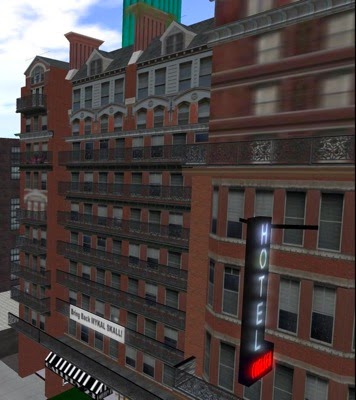
Truth be told, I had never heard of the Hotel Chelsea in Second Life. I had heard of the more solid one in New York City - once home to a number of writers and musicians (perhaps most infamously known as where Dylan Thomas died of alcohol poisoning, and where Sid Vicious and Nancy Spungen lived and Spungen died) and now in the midst of a renovation. Built in 1883 and originally run as a co-op apartment building, it was recast as a hotel in 1905.

Then various blogs, including Prim Perfect and Crap Mariner, mentioned that there was not only a Second Life replica of the original - one that offered rooms to let, exhibits, and live music - but that the hotel was about to disappear, a victim of reduced donations, reduced interest in Second LIfe, high tier,…it's always hard to tell what the fatal blow is for a sim, as the cause of death is usually a combination of things. At any rate, before I could see what the fuss was about, notice came that the sim had gotten a reprieve.

From the notecard:

Hello Fellow Bohemians

Welcome to the Virtual Hotel Chelsea

Please feel free to look around the Hotel, and enjoy the Art and Ambience. We have Gallery 23 where we feature SL artists to the left of the hotel, and gallery row to the right where more Sl artist show their work. There are also galleries and shops to be seen all over the sim, so check them out as well.

You may also visit room 100 where Sid and Nancy lived ( and nancy died) , and room 211 where Bob Dylan lived. As well as several residents rooms that are open to the public, just click on the doors.

We have residential rooms for rent, these are unfurnished and vary in price and prim allowance. We also have rooms that you can rent for one day at a time, these rooms are furnished and have no prim allowance.

We have Live events including Live music, and poetry readings. Most of the Live music is on Tuesday, Thursdays, and Saturdays. Check the marquee next to the stage for information or ask your host.

We also have Literary Night on Wednesdays at 6pm. This is an open forum where anyone may read, we have published authors who join us and read from thier own works. You can read your own poetry or flash fiction, or anything else you want.
Enjoy your visit !

Hotel Chelsea 004

Hotel Chelsea 005

The hotel is clearly under substantial (virtual) renovation, so I'll have to return after it is completed. I can only imagine how prim-heavy the entire setup is…it must cost a virtual arm and leg to maintain. Or perhaps a real arm and leg.

Hotel Chelsea 001

In any event, there is a Wall of Shame for real life residents of the hotel and, of course, I found the bar.

Hotel Chelsea 002

The lobby shows the hotel's bohemian focus, with arty pictures and mismatched furniture.

Hotel Chelsea 003

It remains to be seen whether this incarnation of the hotel can make a go of it…then again, the same can be said for all of us, I suppose.

Monday, April 2, 2012

Travelogue: Templemore

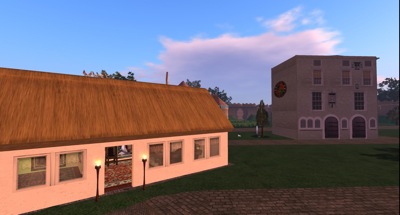
Up from the waters where Caer Firnas once stood is the newest addition to Caledon, dubbed Templemore.

Templemore 3 21 12 001

Miss Elspeth Wooley has constructed a version of Victorian-era Galway City in Ireland. She has some, well, unusual additions, however:

Templemore 3 21 12 002

Inside the city walls are several small houses, some larger buildings, and an old stone church.

Templemore 3 21 12 003

Templemore 3 21 12 004

I thought the name "Templemore" sounded familiar, and indeed much of the land seems to have migrated into the territorial waters of Caledon, whereas it had once been part of the allied state of Magellan.